
 fastfixoffice@yahoo.com
 Book Appointment
 Your garage door weighs between 130 pounds for a single-panel steel door and 400+ pounds for a wide insulated double door with windows. The opener motor is not strong enough to lift that on its own. The motor only lifts about 10 to 15 pounds of net weight. Springs do the rest of the work by counterbalancing the door so it feels almost weightless when you raise it.
When a spring breaks, the garage door opener tries to lift the full weight, fails, and either burns out the motor, snaps the lift cables, or refuses to move at all. This is why a broken spring often gets misdiagnosed as a bad opener. The opener is fine. The counterbalance is gone.
A working spring does three jobs at the same time. It holds the closed door up off the floor seal so the bottom rubber is not crushed. It feeds energy back into the door during opening, so the motor only handles balance. It controls the descent so a closing door does not slam into the concrete.
The two spring types and how to tell which you have
Most homes have one of two systems.
Torsion springs: sit horizontally above the door on a metal shaft. They are thicker, shorter, and wound tight under tremendous tension. A typical torsion spring stores 25,000 to 35,000 inch-pounds of energy when the door is closed. That energy is what makes them dangerous.
Extension springs: run along the horizontal tracks on each side of the door. They are longer, thinner, and stretch when the door closes. Extension springs require a safety cable threaded through the center to keep them from launching across the garage if they snap.
To identify yours, stand inside the closed garage and look up. If you see one or two thick coiled springs above the door on a steel shaft, those are torsion springs. If you see long, thin springs running along the tracks parallel to the ceiling, those are extension springs.
Both types fail the same way. Metal fatigue from repeated cycling causes microscopic cracks that propagate until the spring snaps, usually with a loud bang that sounds like a gunshot.
Why broken spring DIY is genuinely dangerous
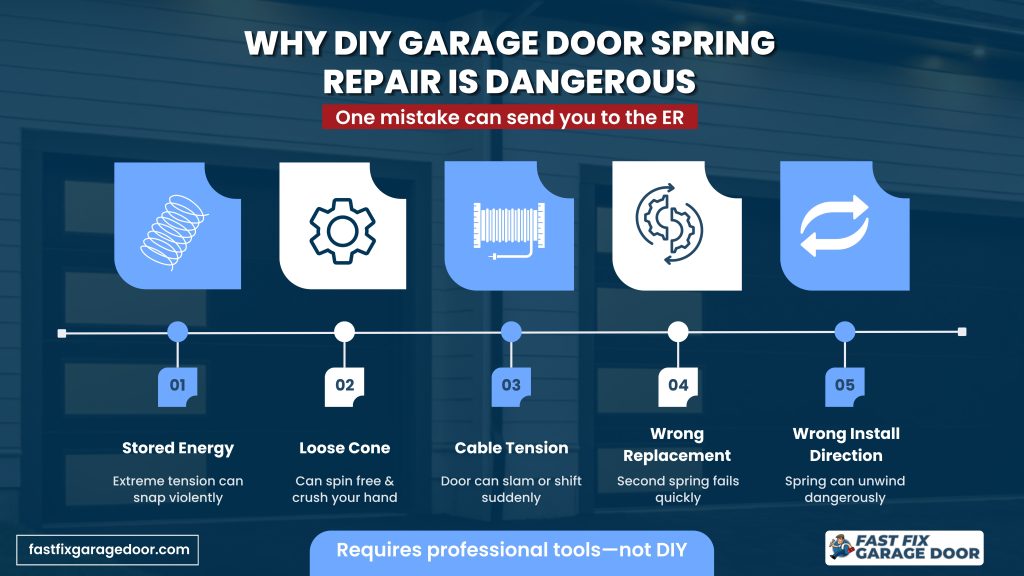
The internet is full of YouTube tutorials showing torsion spring replacement. Most of them gloss over the part where one slip can put you in the hospital.
The energy problem: A wound torsion spring on a 7-foot door holds roughly 30,000 inch-pounds of stored energy. If a winding bar slips out of the cone while you are rotating it, that bar becomes a steel projectile rotating at high speed. It can break fingers, fracture wrists, knock out teeth, and crack skulls. Emergency rooms see these injuries every week.
The cone problem: Torsion spring cones are fastened to the shaft with two set screws. If those screws strip or were never properly tightened from a previous repair, the cone can spin free under tension. Anything between the cone and a wall, including your arm, gets crushed.
The cable problem: The lift cables that connect the bottom of the door to the cable drums are under load even when the spring is broken. If you disconnect them incorrectly, the door can slam down or shift sideways unexpectedly.
The matched pair problem: Both springs in a two-spring system carry the same load. When one breaks, the other has reached the end of its life cycle, too. DIYers often replace only the broken one, and the second one fails within weeks, doubling the labor cost.
The wind direction problem: Torsion springs come in left-wound and right-wound versions. Installing the wrong wind direction means the spring will unwind itself the first time the door opens. The shaft can spin backward fast enough to throw the cable drums.
The professional tools required for safe replacement include calibrated winding bars at the correct diameter for the cone, a torque wrench for the set screws, and a spring scale to verify door balance after installation. A claw hammer and a pair of rebar rods are what send people to the ER.
What an honest pro charges in 2026
Here is what fair market pricing looks like in most US metros for a standard 16-foot wide insulated steel garage door.
Single torsion spring replacement: $180 to $350. This includes the spring itself, labor, and a basic balance check.
Pair of torsion springs (recommended when one breaks): $250 to $450. Replacing both makes sense because they are the same age, and the unbroken one is on borrowed time.
Extension spring replacement (single): $150 to $250. Pair: $200 to $350.
Heavy-duty oversized door springs (wood doors, glass panel doors, custom widths): $350 to $700.
After-hours or same-day service fee: Add $50 to $150.
Service call fee (sometimes waived if work is performed): $50 to $95.
Cable replacement at the same time: Add $40 to $90.
Drum replacement if drums are worn: Add $60 to $120.
A reasonable total for a standard suburban home with both torsion springs replaced, a service call fee, and new lift cables falls in the $300 to $500 range. Anything above $700 for a basic residential job needs a second opinion.
Pricing varies by region. Dallas, Houston, and Phoenix run on the lower end. Chicago, Seattle, and Boston run higher due to labor costs. Rural service areas charge a trip fee that adds $50 to $100.
Why does same-day service cost more
Spring failures are emergencies because the door cannot be opened or closed safely. Cars are trapped inside, or the door is stuck in a partially open position, which is a security risk.
Same-day technicians carry inventory on their trucks, work after normal business hours, and skip past the regular schedule. The premium of $50 to $150 covers that. If your door is closed and your car is inside the garage, but you do not need it that night, you can save money by booking next-day standard service instead of emergency.
The exception is if the door is stuck open. That is a security and weather emergency, and the premium is worth paying.
Single spring vs both springs replacement
This is where homeowners get pressured by upsell scripts.
Honest answer: If your door has two torsion springs and one breaks, both should be replaced. They were installed at the same time, have the same cycle count, and use the same wire diameter. The unbroken one has reached the same fatigue point as the broken one and will fail within weeks or months.
Replacing the matched pair costs roughly $80 to $150 more than a single spring, but you avoid a second service call, second trip fee, and second labor charge that together would exceed the cost of buying both at once.
If your door has only one spring (common on lighter single-car doors), replace just that one.
If a technician tells you both springs need replacing on a one-spring system, that is a red flag.
Red flags when getting a spring quote
Watch for these tactics from low-quality companies.
Bait and switch pricing: Online ads showing a $69 spring repair almost always end at $400+ after upsells. The $69 covers the service call only. A real spring job is at least $180 in parts and labor.
Forced upgrades: Pressure to replace the opener, tracks, rollers, drums, and cables all in one visit when only the spring failed. A spring failure does not damage the opener. Rollers and tracks are usually fine.
Lifetime warranty pricing: Some companies charge $600 to $800 for a “lifetime” spring with the promise of free replacement forever. The math rarely works in your favor. Standard 10,000-cycle springs are $40 to $60 in parts and last 7 to 12 years for an average household. A 20,000-cycle spring at $80 to $120 in parts lasts 14 to 24 years. Both are far cheaper than the lifetime upgrade unless you replace the door more than three times.
Door replacement push: A working door with a broken spring does not need replacement. If the technician recommends scrapping a 5-year-old door because of one bad spring, get another quote.
No written quote before work starts: A real company gives you a written estimate listing parts, labor, fees, and warranty before lifting a tool. Verbal “we will figure it out” pricing leads to disputed bills.
How long should a new spring last
Spring life is measured in cycles, not years. One cycle equals one full open and close.
A standard 10,000-cycle spring lasts:
- 7 years for a household opening the door 4 times per day
- 14 years for a household opening it twice per day
- 4 years for a busy household opening it 7+ times per day
Upgrade options:
- 20,000-cycle spring (most homes ask for this): doubles lifespan, costs $40 to $80 more
- 30,000 cycle spring: triples lifespan, costs $90 to $150 more, worth it if you have a home office, multiple cars, or work from home with frequent door cycles
Ask for the cycle rating in writing. A surprising number of repairs use whatever cheap spring is on the truck without specifying.
What to Do Right Away If Your Garage Door Spring Breaks
If you hear a sudden loud bang from the garage and the door refuses to open fully, or only lifts a few inches before stopping, the spring has likely broken. In that moment, the safest thing you can do is stop using the opener immediately. Continuing to force the motor to lift the door can damage the opener and turn a simple spring replacement into a much larger repair.
Disconnect the system using the red emergency release cord so the opener is no longer attached to the door. After that, avoid trying to lift the garage door yourself. A garage door without a functioning torsion spring can weigh hundreds of pounds, and without proper counterbalance support, it can fall unexpectedly and cause serious injuries.
If the door is closed and your vehicle is trapped inside, it’s often smarter to wait until the next day for regular service instead of paying expensive emergency rates overnight. If the door is stuck partially open, carefully support it from underneath and keep children, pets, and anyone else away from the area until help arrives.
At Fast Fix Garage Door, we always recommend getting at least two quotes before booking spring repair service. Honest garage door companies should have no problem explaining the issue clearly and giving same-day pricing over the phone before dispatching a technician.