
 fastfixoffice@yahoo.com
 Book Appointment
 For most Collin County homes with an attached garage, a belt drive is the opener we recommend, especially if a bedroom or living room sits over or beside the garage. Belt runs the quietest (roughly 55 to 60 dB), chain is the cheapest and loudest (about 70 to 80 dB), and screw sits in the middle on both. The catch is specific to North Texas: screw drive units are temperature sensitive, and our summer garages routinely hit well over 100 degrees, so we steer most local buyers away from screw for that reason alone. Pick based on where the garage sits in your house, not just the sticker price.
What This Comparison Actually Settles For You
Every opener brochure claims to be quiet and reliable, which is useless when you are standing in the garage aisle trying to decide. This guide cuts through that with real numbers we see on jobs, not marketing copy. We walk through how belt, chain, and screw drives compare on noise, upfront and long-term cost, and how much upkeep each one demands. Then we get into the part almost no national article covers: why our North Texas heat matters for screw drives, and why a bedroom over the garage changes the whole math. By the end, you will know which drive fits your house and your budget before anyone quotes you.
How Belt, Chain, and Screw Drives Are Different
All three do the same job. A motor pulls or pushes a trolley along a rail, and the trolley raises and lowers the door. The difference is what connects the motor to that trolley, and that one detail drives almost everything you care about: noise, price, and how often you have to touch it.
A chain drive uses a metal chain, like a bicycle chain. It is strong, cheap, and loud. A belt drive swaps that chain for a reinforced rubber belt, which is why it runs so much quieter. A screw drive turns a long threaded steel rod, and the trolley rides along the threads. Fewer moving parts, but that steel rod does not love temperature swings.
That is the whole story in one paragraph. The rest of this guide is about which trade-off is right for your specific garage.
The quick version before we get into detail
- Chain: loudest, cheapest, toughest on heavy doors, needs the most lube.
- Belt: quietest, costs more upfront, low upkeep, best for attached garages.
- Screw: middle on noise and price, low upkeep, but heat sensitive.
Noise: The One Spec That Matters Most In An Attached Garage
If your garage shares a wall or a ceiling with a room you actually live in, noise is the spec to obsess over. Here is roughly how the three drives land, based on manufacturer ratings and what we hear in the field.
| Drive type | Typical noise level | Real-world comparison |
| Belt | About 55 to 60 dB | A normal conversation |
| Screw | About 65 to 75 dB | A running microwave |
| Chain | About 70 to 80 dB | A vacuum cleaner in the next room |
Those numbers look close on paper. They are not close at 6 a.m. when someone leaves for work, and the door is directly under a bedroom. A chain drive does not just make noise; it sends vibration through the rail and into the framing, so the sound travels through the structure of the house, not only the air. Belt drives cut both the sound and most of the vibration, which is why they are the quietest garage door opener for people who share a wall with their garage.
Here is a practical detail worth more than the dB chart: the opener is often not even the loudest part. Old steel rollers, a dry torsion spring, and loose hinges can be louder than the motor itself. On plenty of North Texas homes, we have quieted a “loud opener” by swapping to nylon rollers and lubricating the spring, no new opener needed. Ask about that before you assume the drive type is your problem, and if the door itself is banging or shaking on the way up, a garage door repair visit may fix the noise cheaper than a whole new opener.
One more thing on noise that homeowners rarely think about: the mounting matters. An opener bolted straight to the ceiling joists over a bedroom transmits vibration into the room no matter which drive you buy. We often add rubber isolation mounts or a support strut when we install over a living space, and that small step does more for perceived quiet than people expect. A belt drive on solid, isolated mounting is genuinely hard to hear from the room above.
Price: Upfront Cost Versus What You Pay Over Ten Years
Sticker price only tells part of the story. Here are honest ranges for the opener unit itself, labeled as ranges because brand, horsepower, and features move the number around.
| Drive type | Typical unit price | Long-term upkeep cost |
| Chain | About $150 to $300 | Higher (regular lubrication, chain wear) |
| Screw | About $250 to $400 | Low (few moving parts) |
| Belt | About $220 to $500 | Low (belt rarely needs service) |
For a professional garage door opener installation on top of the unit, expect a labor range in the neighborhood of $100 to $200 depending on whether we are reusing your existing rail and wiring or starting fresh. If your current setup is a 20-year-old chain unit with a failing logic board, a full replacement is usually the smarter money than repairing it piece by piece.
Features move that number too. A basic chain unit with two remotes sits at the bottom of the range. Add battery backup (required by law on new residential openers in some states and a real convenience during our summer storm outages), Wi-Fi with phone control, and a stronger motor for a heavy double door, and you climb toward the top. We usually tell people to buy the drive type their house needs first, then add only the features they will actually use, rather than paying for a smart opener and never opening the app.
Chain wins on day one. Belt often wins over ten years, because you are not re-lubricating a chain every season and the belt itself rarely needs attention. If you plan to stay in the house, the belt premium usually pays for itself in quiet and low maintenance. If it is a rental or a detached shop where nobody hears it, chain is the honest, budget-smart pick.
Why Screw Drives And North Texas Summers Do Not Mix
This is the section the national comparison articles skip, and it is the one that matters most for a Collin County buyer. Screw drives rely on a threaded steel rod, and steel expands and contracts with temperature. The manufacturers themselves warn against using screw drives in areas with big temperature swings.
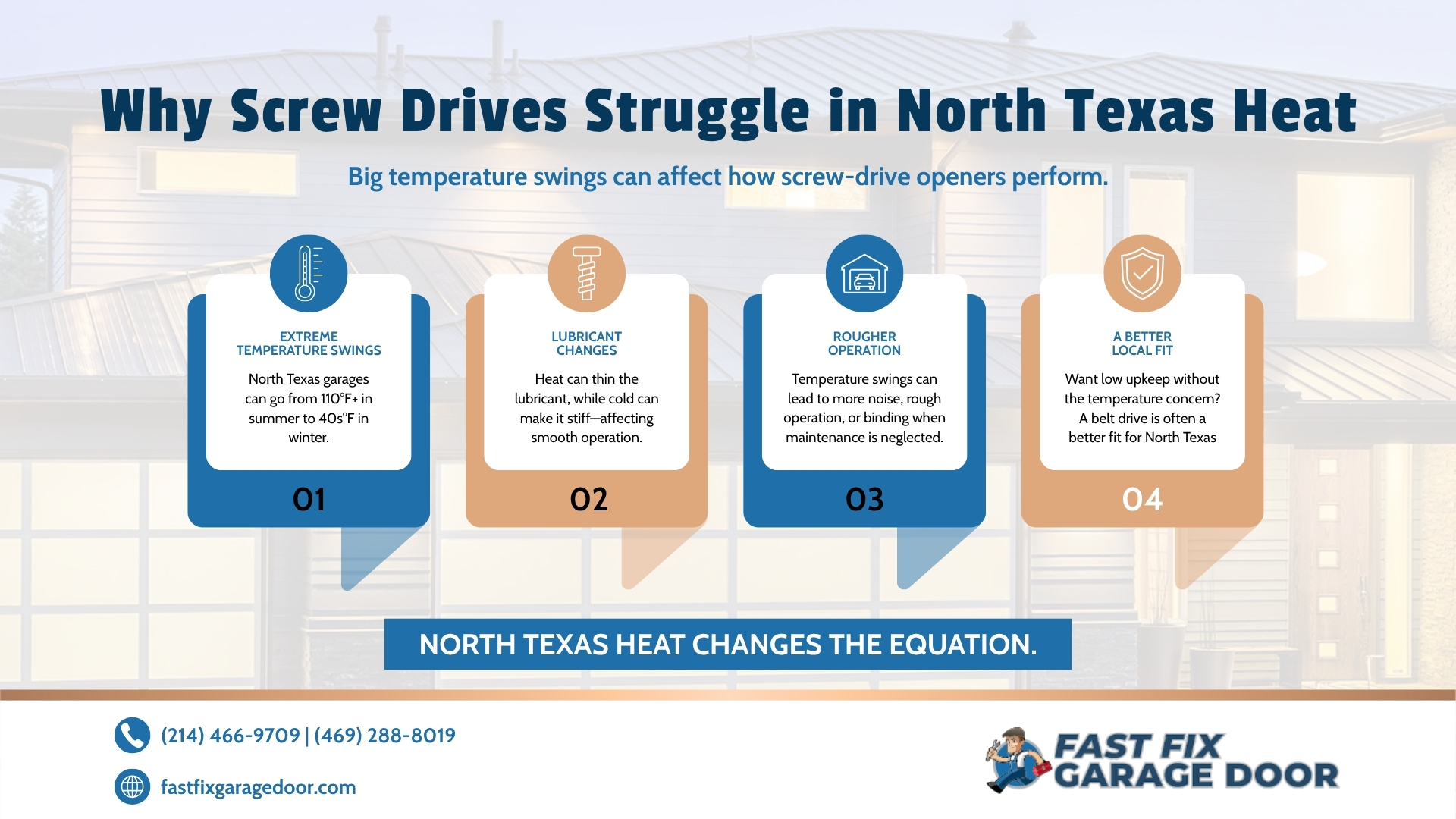
North Texas garages are exactly that environment. An attached, uninsulated garage in Plano, Frisco, or McKinney can sit past 110 degrees inside on a July afternoon, then drop into the 40s on a January morning. That range makes the lubricant on a screw drive thin out in the heat and stiffen in the cold, so the unit can run rough, get louder over time, or bind if it was not kept greased.
In our experience across the Collin County area, that is enough to move most local buyers off screw drives. They are a fine choice in a mild, climate-controlled garage. Ours are neither for most of the year. If you love the low-maintenance idea of a screw drive, a belt drive gets you nearly the same low upkeep without the temperature problem, which is why we usually point people there instead.
Maintenance: How Often You Actually Have To Touch Each One
Nobody buys an opener planning to service it, but the upkeep gap between these three is real over a decade.
A chain drive wants lubrication on the chain and rail a couple of times a year in our climate, and more often if the garage runs hot. Skip that, and the chain gets louder and wears faster, which is how a chain unit that was fine at purchase turns into the loud opener everyone complains about five years later. A belt drive is close to set-and-forget by comparison. The belt does not need regular greasing, there is no chain to stretch, and a yearly look at the rollers, springs, and safety sensors is plenty. Screw drives sit awkwardly in the middle: the threaded rod has to stay properly greased with the right lubricant, and our heat works against you there, which loops straight back to why we do not love them locally.
Whatever drive you pick, the springs and rollers matter more to the whole system’s lifespan than the opener does. A well-kept door makes any opener last longer, because the motor is not fighting a door that binds. When we get a call about an opener that “died young,” the real culprit is usually a door that was never balanced, so the motor spent years lifting more weight than it should have.
Which Opener Fits Your North Texas Home
Match the drive to where the garage sits and how you use it, not to whichever unit is on sale that week.
If a bedroom or living room sits over or beside the garage, go belt drive. There is no real debate here, and the quiet is worth it every single morning when the door runs. For a detached garage or a backyard shop where nobody hears it, chain drive is the honest pick. It is cheap, it laughs at heavy doors, and the noise is a non-issue out there.
Door weight changes things too. A heavy or oversized double door wants either a chain drive or a belt drive with enough horsepower behind it, so confirm the motor is rated for what it is lifting before you buy. And if you want the quietest possible setup and the budget allows, look at a wall-mount jackshaft opener. It mounts beside the door instead of overhead, frees up your ceiling for storage, and is the quietest option we install because there is no overhead rail carrying vibration into the room above.
Most homes we serve in Plano, McKinney, Frisco, Allen, Prosper, Wylie, and Celina have attached garages with bedrooms nearby, which is why we install far more belt and wall-mount units here than anything else. It is not a coincidence. It is the housing stock. New construction across Collin County leans heavily toward the bonus-room-over-garage layout, and those buyers feel a chain drive the first morning they use it. If you are pairing a new opener with a new door, our garage doors lineup and the opener choice should be sized together so the motor is not overworked from day one.
What A Good Install Includes
A new garage door opener is only as good as the setup around it. When we quote a job, we are checking that the door is balanced first, because a heavy or off-balance door burns out any motor early. We reset the travel and force limits so the door stops in the right spots and reverses when it should; we test the photo-eye safety sensors, and we make sure the wall button and remotes are paired. If your old rollers or springs are on their way out, we will tell you, because putting a new motor on a failing door just moves the failure downstream.
What we check before we call an install finished
A finished install is not just a motor that runs. We confirm the door reverses on contact when something breaks the sensor beam, because that safety reversal is what stops a door from closing on a car bumper or a kid’s bike. We check that the force setting is not cranked so high that the opener muscles through a problem instead of stopping. And we walk you through the remote, the keypad, and the app if the unit has one, so nobody is standing in the driveway a week later trying to reprogram a remote from a manual. On a hot North Texas afternoon, we also verify the battery backup engages, since our summer storms knock out power at the worst times and a stuck door in a 110-degree garage is nobody’s idea of fun.
Where to go from here
The honest short version: pick belt if your garage touches a room you live in, pick chain if it does not and you want to save money, and skip screw drives given our summers. If you would rather have someone confirm the right drive for your specific door and handle the garage door opener installation cleanly the first time, the team at Fast Fix Garage Door does exactly that across Collin County. We will match the opener to your door weight and your home layout, not just sell you the priciest box on the shelf.