
 fastfixoffice@yahoo.com
 Book Appointment
 Commercial overhead doors fall into three broad categories before you start picking features. Sectional steel doors are the standard. They roll up in horizontal panels along curved tracks and store flat against the ceiling. You see them in warehouses, repair shops, fire stations, and self-storage facilities. They handle frequent cycles and large openings. Most are 24 or 25 gauge steel skin over a polyurethane or polystyrene core, or just two layers of steel for non-insulated versions.
Aluminum full-view doors: swap most of the panel for tempered glass or polycarbonate panels held in an anodized aluminum frame. Auto dealers, fire stations, breweries, and restaurants pick these for the natural light and the showroom feel. They cost more, insulate worse, and weigh less than steel sectionals.
Rolling steel doors coil into a metal cylinder above the opening. They are common on storefronts, loading docks, and self-storage. Different from sectional commercial garage doors service and outside the scope of this guide, but worth mentioning so you know they exist.
Steel sectional doors: workhorse of commercial buildings
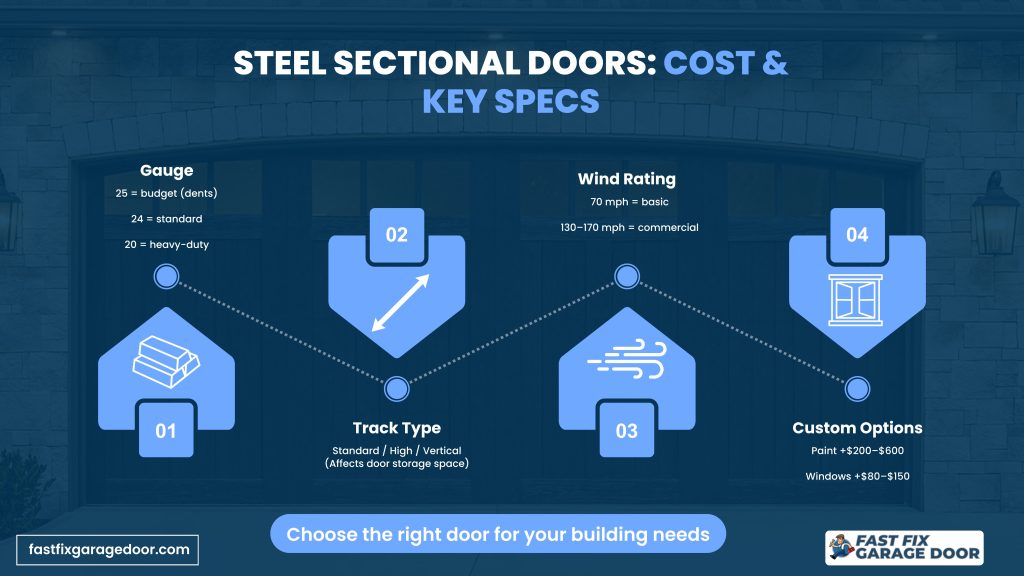
A 12-foot by 12-foot non-insulated steel sectional door installed runs $1,200 to $2,800, depending on gauge, manufacturer, and operator. Insulated versions of the same opening run $1,800 to $4,500.
Gauge matters: 25-gauge skin is the budget option and dents easily from forklift bumps. 24 gauge is the standard. 20 gauge is heavy commercial and stands up to industrial use without dings.
Track types: Standard lift, high lift, and vertical lift change where the door stores. Standard lift is the cheapest. High lift moves the door higher into the ceiling, useful when you want to mount equipment below the stored door. Vertical lift sends the door straight up and is required when ceiling clearance is limited, but headroom above the opening is not.
Wind load ratings: Coastal areas (Texas Gulf Coast, Florida, Carolinas) require wind-rated doors. Standard residential-grade doors fail in 70 mph winds. A wind-rated commercial door holds up to 130 to 170 mph, depending on the rating.
Color and panel options: Most manufacturers offer 4 to 8 standard colors. Custom paint adds $200 to $600. Window inserts cost $80 to $150 each.
Steel sectionals are the right choice when you need reliability, a wide opening, and you do not need natural light through the door. They are not the right choice when image matters or when the building is conditioned, and you want a frameless look.
Aluminum full-view doors: when visibility wins
A 12×12 aluminum full-view door installed runs $3,500 to $7,500. Add tempered insulated glass, a custom anodized finish, or oversized openings, and you can hit $12,000+.
Glass options: Single-pane tempered glass is the cheapest and lets the most light through. Double-pane insulated tempered glass cuts heat transfer by half. Frosted, tinted, or low-E coatings cost $200 to $600 extra per panel.
Polycarbonate panels are an alternative to glass. Lighter, less likely to shatter on impact, and less expensive. They scratch more easily and yellow over a decade of UV exposure.
Frame finishes: Mill aluminum (raw silver) is the base. Bronze, black, white, and clear anodized are standard upgrades. Custom powder coat colors run $400 to $800.
Where they make sense: Auto dealerships, motorcycle shops, restaurants with garage-door wall openings, breweries, and fire stations that want to display equipment. Anywhere customers see the door and the building image matters.
Where they do not: Cold storage, food processing, and manufacturing with airborne particles that scratch glass, and anywhere with frequent forklift traffic close to the door.
Insulation is a major weakness. Even with double-pane glass, an aluminum full-view door has an effective R-value of 2 to 4 compared to R-12 to R-18 for an insulated steel door. If your building runs heat or AC with the door closed for long periods, the energy cost is meaningfully higher.
Insulated doors: R-value and what it actually saves
R-value measures resistance to heat transfer. Higher is better.
R-6 to R-9 is entry-level. Polystyrene foam board glued between steel skins. Adequate for an unconditioned warehouse in mild climates.
R-12 to R-14 is the commercial sweet spot. Polyurethane foam is injected between the skins. Better thermal performance, more sound dampening, slightly more dent-resistant than polystyrene.
R-16 to R-18+ is high performance. Thicker polyurethane core, sometimes with thermal breaks at panel joints to prevent thermal bridging through the steel.
Real savings math A 12×12 door open to a conditioned 70-degree space, with outdoor temps averaging 95 in summer and 35 in winter, leaks roughly:
- $180 to $260 per year in HVAC cost at R-6
- $90 to $140 per year at R-12
- $50 to $80 per year at R-18
Over a 15-year service life, the difference between R-6 and R-18 is $1,500 to $2,700. The premium for R-18 over R-6 is usually $400 to $900. Insulation pays for itself in 3 to 5 years for any conditioned commercial space.
For unconditioned warehouses with no heating or cooling, R-value matters less. Pick the cheapest non-insulated or R-6 option.
Sizing your opening correctly
Standard commercial openings:
- 8×8: small bay, mechanic shop service door
- 10×10: light commercial, smaller storefront
- 12×12: standard warehouse, fire station, dealership service bay
- 14×14: heavy commercial, equipment storage
- 16×16+: large warehouse, agricultural
Headroom requirement: Standard lift needs 12 to 18 inches of clearance above the opening. High lift needs more. Vertical lift needs the full door height plus 18 inches. Measure before ordering, or you end up with a door that does not fit your building.
Side room: Tracks need 4 to 6 inches on each side of the rough opening for mounting. Walls thinner than that require special bracket extensions.
Backroom (depth): The door must store far enough back into the ceiling that it does not collide with lights, sprinklers, or HVAC ducts. Plan 12 to 16 feet of clear backroom for a 12-foot-tall door.
If you are unsure of measurements, have a contractor do a site survey before ordering. A wrong-size custom door is a $3,000+ mistake that takes 4 to 8 weeks to correct.
Spring systems and cycle ratings for commercial use
Residential springs are rated for 10,000 cycles. Commercial doors cycle far more.
- Light commercial: 25,000 cycle springs (small business with 10 to 20 cycles per day)
- Standard commercial: 50,000 cycle springs (moderate use, 30 to 50 cycles per day)
- Heavy commercial: 100,000+ cycle springs (loading docks, busy fire stations, 100+ cycles daily)
The cost difference between 25,000 and 100,000 cycle springs is $80 to $200. Always upsize the spring rating to your actual usage. Replacing springs in a commercial setting means lost productive time, not just a service fee.
Operator selection: jackshaft, trolley, or hoist
Trolley operators are residential-style overhead motors mounted on the ceiling. Cheap. Fine for low-cycle commercial up to 12-foot wide doors. Limited to about 20 cycles per hour before overheating.
Jackshaft operators mount on the wall beside the door and drive the torsion shaft directly. Free up ceiling space, suit high lift and vertical lift configurations, and handle higher cycle rates than trolley operators. Costs $400 to $900 more than a trolley.
Industrial hoist operators are geared-reduction motors built for 100+ cycles per hour all day. Loading docks, factories, fire stations. Costs $1,200 to $2,500 plus installation.
Match the operator to actual use. Undersized operators burn out within 2 years on doors that cycle frequently. The savings of choosing a $300 trolley over a $700 jackshaft disappear when you replace the trolley three times.
Total cost of ownership over 15 years
Sample 12×12 commercial door, conditioned space, 30 cycles per day.
Option A: Non-insulated 25-gauge with trolley operator
- Initial install: $1,400
- HVAC leak cost over 15 years at R-2: $3,000
- Operator replacement (year 5 and year 10): $700 (2 trolleys)
- Spring replacement (year 4, 8, 12): $900 (3 service calls)
- Total 15-year cost: $6,000
Option B: Insulated 24-gauge R-14 with jackshaft operator
- Initial install: $3,200
- HVAC leak cost over 15 years at R-14: $1,200
- Operator replacement (year 12): $750
- Spring replacement (year 10): $400 (50,000 cycle springs)
- Total 15-year cost: $5,550
The insulated option costs $1,800 more upfront but $450 less over 15 years. It also fails less often, looks better for longer, and tolerates the inevitable forklift bump.
Code requirements and wind load ratings
The International Building Code (IBC) governs commercial doors. Most jurisdictions adopt the IBC with local amendments.
Wind load: Required in coastal high-velocity zones. Florida HVHZ requires Miami-Dade County NOA-rated doors. Texas coastal counties require windstorm certification. Failure to use a rated door voids commercial property insurance after a hurricane claim.
Egress requirements: Doors used as the primary exit from an occupied space must have a manual release that does not require keys, tools, or special knowledge. Most commercial overhead doors are not egress doors. The personnel door beside them is.
Fire ratings: If the door is in a fire-rated wall, the door must match the wall rating. Fire-rated overhead doors have automatic closers triggered by fusible links or smoke detectors. Costs $1,500 to $4,000 more than standard doors.
ADA accessibility: Not usually required for overhead doors themselves, but the personnel access path must comply.
When in doubt, check with the local building department before ordering. A non-compliant door fails inspection, and you eat the cost of replacement.
Final Thoughts
The best commercial overhead door depends on how your building actually operates. Steel sectional doors are the practical choice for most warehouses and service buildings because they balance durability, cost, and insulation performance. Aluminum full-view doors work better for businesses that prioritize visibility and appearance, while higher-cycle spring systems and industrial-grade operators are essential for facilities with constant daily use.
Before buying, look beyond the installation quote and consider long-term operating costs like energy efficiency, maintenance frequency, spring lifespan, and operator replacement. In many cases, spending more upfront on insulation and heavier-duty hardware reduces downtime and lowers ownership costs over the life of the door.
At Fast Fix Garage Door, we help commercial property owners compare door materials, insulation ratings, lift types, and operator systems based on the actual demands of the building. A proper site evaluation and accurate measurements upfront can prevent expensive ordering mistakes and ensure the door performs reliably for years.