
 fastfixoffice@yahoo.com
 Book Appointment
 A garage door is one of the most important moving parts of your home, providing security, convenience, and curb appeal. When problems arise, many homeowners wonder whether they should invest in garage door repair or replace the entire system. From broken springs and damaged panels to faulty openers and worn-out components, some issues can be resolved with professional garage door services. In contrast, others may signal that replacement is the smarter long-term investment. The right choice depends on factors such as the door’s age, condition, repair history, and overall performance. By understanding the differences between garage door repair and replacement, you can make an informed decision that improves safety, enhances energy efficiency, and helps you get the most value from your home.
Start by figuring out what’s actually wrong
Before you decide anything, you need to know what you’re dealing with. A lot of homeowners assume the worst the moment the door won’t open, but plenty of problems are small and cheap to fix. On the other hand, some issues that look minor are signs of a bigger problem beneath the surface.
Here are the common issues people run into:
- Broken springs. This is the most common repair, and it’s almost always worth fixing rather than replacing the whole door. Springs wear out over time, and a spring repair gets you back to normal without touching the rest of the door.
- Snapped or frayed cables. Cables usually go along with worn springs. They’re a routine fix and not a reason to replace a good door.
- The door is off its track. Sometimes a bumped track or a worn roller pulls the door off line. Often fixable, but if the panels bent in the process, that changes things.
- A dead or noisy opener. The opener is a separate machine from the door itself. You can swap a garage door opener without touching the door, which is good news for your wallet.
- Dents and cracked panels. One dented panel can sometimes be swapped out. Several damaged panels start to add up, and that’s where replacement enters the picture.
If you’re not sure which of these you’re facing, that’s normal. A quick inspection from a technician usually clears it up, and it keeps you from guessing wrong and spending money in the wrong place.
The age of the door tells you a lot
Age is one of the biggest factors in this decision. A standard steel garage door lasts somewhere between 15 and 30 years, depending on how it was built and how well it was looked after. Wood doors can have a shorter or longer life depending on the weather and upkeep.
If your door is under ten years old and runs into a single problem, repair is almost always the smart move. The door still has plenty of life left, and a repair is a small fraction of what a new one costs. But once a door crosses the fifteen-year mark and starts needing repair after repair, the math begins to shift. At some point, you’re pouring money into a door that’s going to need replacing anyway.
A good rule of thumb: if you’ve called for service three or more times in a couple of years, the door is telling you something. Add up what you’ve spent. If those repairs are creeping toward half the price of a new door, replacement starts to look like the better deal.
Think about more than just the immediate fix
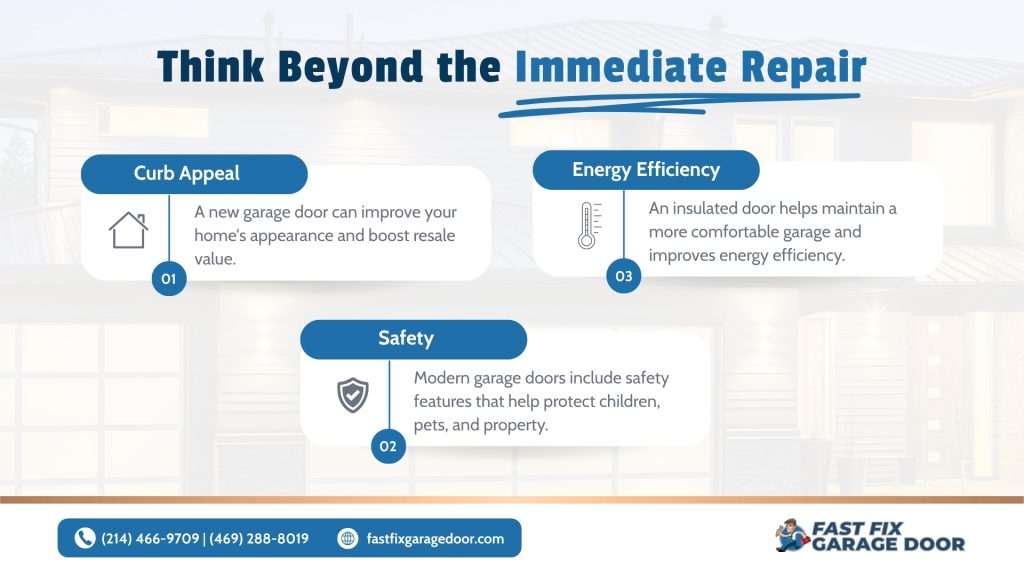
A garage door does more than open and close. It affects how your home looks from the street, how energy-efficient your garage is, and how safe your family is. These things matter, and they should be part of the decision.
Curb appeal
Curb appeal is real. The garage door is often the largest single feature on the front of a house. A faded, dented, mismatched door drags down the look of the whole place. If you’re planning to sell anytime soon, a fresh door is one of the upgrades that tends to pay you back at closing time.
Energy efficiency
Older doors usually have little or no insulation. If your garage is attached to the house, an uninsulated door lets heat pour in during a hot Texas summer and lets cold seep in during winter. A modern insulated door helps keep the garage closer to a steady temperature, which can ease the load on your HVAC and make the space more usable year-round.
Safety
Doors made before the early 1990s may not have the auto-reverse feature that stops the door if something is underneath it. If you’ve got kids or pets, that’s not a small thing. A door without modern safety features is worth replacing for that reason alone.
When to repair vs. when to replace
When repair is clearly the right call
Repair usually wins when the door is fairly young, the body of the door is in good shape, and the problem is a single worn part. Springs, cables, rollers, and openers are all parts that wear out on a normal schedule. Replacing them is routine, affordable, and gets you many more years out of a door you already own.
It also makes sense to repair when only the mechanical parts are failing, but the panels look great. There’s no reason to throw away solid panels because a spring snapped. That’s like buying a new car because you got a flat tire.
When replacement makes more sense
Replacement starts to win when the door itself is the problem, not just the parts attached to it. Here’s when I’d lean toward a new door:
- The panels are dented, cracked, or rusted in several spots, and matching replacement panels are hard to find.
- The door is old enough that parts are getting scarce or no longer made.
- You’re dealing with repeated breakdowns, and the repair bills keep climbing.
- The door has no modern safety features and can’t be safely upgraded.
- You want better insulation, a quieter door, or a fresh look for the front of your home.
A new door is a bigger upfront cost, no question. But when you factor in fewer repairs, lower energy bills, better security, and the boost to your home’s appearance, a new garage door often turns out to be the smarter long-term choice.
What about the cost?
Costs vary a lot based on the part, the materials, and the type of door, so anyone who throws out a flat number without seeing your setup is guessing. A basic spring or cable repair sits at the lower end. An opener replacement is in the middle. A full door replacement is the biggest expense, and the final number depends on the material, the insulation, the size, and any custom features you choose.
The honest way to handle this is to get a clear inspection and a written estimate before any work begins. A trustworthy company explains what’s wrong, lays out your options, and lets you decide without pressure. If someone is rushing you or refuses to put a price in writing, that’s a red flag worth paying attention to.
Don’t overlook regular maintenance
Here’s something a lot of homeowners miss: many repair-or-replace situations could have been delayed, or avoided altogether, with basic upkeep. A garage door has dozens of moving parts working together every time it goes up and down. Springs stretch, rollers spin, hinges flex, and cables wind and unwind. When those parts are clean, lubricated, and properly adjusted, the whole system lasts longer and breaks down far less often. A simple tune-up once or twice a year goes a long way.
A tune-up usually includes lubricating the moving parts, tightening loose hardware, checking the spring balance, and making sure the safety sensors are lined up. None of that is expensive, and it can add years to a door that might otherwise be on the edge of replacement. If you’ve been neglecting this, a maintenance visit might buy your door more time and push the big decision further down the road.
Think of it the way you think about your car. Regular oil changes and check-ups keep it running for years. Skip them, and small problems pile up until you’re facing a major repair. A garage door works the same way, and a little attention now saves you money later.
The Texas weather factor
Where you live plays a part, too. In North Texas, doors deal with long, hot summers and the occasional hard freeze. Heat can wear on the opener motor and dry out the lubrication faster, while sudden cold snaps make metal parts contract and can leave a worn spring more likely to snap. Humidity swings can also affect wooden doors, causing them to expand and contract over time.
If your door already struggles in extreme weather, that’s worth factoring in. A newer, well-built door with proper insulation handles temperature swings better and tends to need fewer weather-related repairs. For an older door that acts up every summer or winter, the climate is one more point on the replacement side of the scale.
Mistakes to avoid when deciding
When people get this decision wrong, it’s usually for one of a few reasons. Knowing them ahead of time helps you steer clear of the same traps.
- Going with the cheapest quote without asking what’s included. A low price can mean low-quality parts that fail again soon. Ask what brand of springs or opener they’re using and whether labor is covered.
- Ignoring repeated small repairs. One fix here, another fix there, and you don’t notice how much you’ve spent until you add it all up. Keep track. The total tells the real story.
- Replacing the whole door when only the opener failed. These are separate systems. Make sure you know which one is actually the problem before paying for a full replacement.
- Waiting until the door fails. A door on its last legs is easier to plan for than one that quits on a freezing morning when you’re already late for work. If you see the warning signs, start planning early.
Slowing down and asking a few good questions protects you from spending money in the wrong place. A door is a long-term part of your home, so it’s worth taking the time to get the choice right.
A simple way to make the decision
If you want a quick gut check, ask yourself three questions. First, how old is the door? Second, is the problem a worn part or damage to the door itself? Third, how many times have I had to fix it lately? If the door is young, the issue is a single part, and breakdowns are rare, repair it. If the door is old, the body is damaged, and you keep calling for help, it’s probably time for a new one.
And when you genuinely can’t tell, get a second opinion from someone who works on these every day. A short visit can save you from spending money on the wrong choice.
Final thoughts
Deciding whether to repair or replace your garage door doesn’t have to be stressful. It comes down to the age of the door, what’s actually broken, and how often it’s been giving you trouble. Small problems with a healthy door call for a repair. An old, beat-up door with a habit of breaking down is usually ready to retire. Either way, the goal is the same: a door that opens smoothly, keeps your home secure, and doesn’t surprise you at the worst possible moment.
If you’re in the McKinney area or anywhere across North Texas and you’d rather have a straight answer than a guess, the team at Fast Fix Garage Door can take a look, explain your options in plain terms, and help you choose the path that makes the most sense for your home and budget.