
 fastfixoffice@yahoo.com
 Book Appointment
 TL;DR
If your garage door is loud, sluggish, or uneven when it opens, if it slams shut instead of settling gently, or if you see a visible gap in the spring coil above the door, those are the clearest signs your springs weakened over the winter and need attention soon. Waiting usually makes the repair bigger and more expensive.
Winter is brutal on garage doors. All those freezing mornings, the heavy slams, the icy tracks, the oil that turns gummy overnight. Your garage door might still open and close, but underneath that quiet routine, the springs are doing most of the work. And after a long winter, those springs start to show it. If your door has been making new noises, moving more slowly, or feeling heavier than usual, you might be dealing with weak garage door springs after winter, and catching the signs early saves you from a sudden snap that can leave you stuck outside on a busy morning.
We’ve been out on service calls across the area all spring, and the same pattern shows up every year. Homeowners think their opener is failing, their remote is dying, or their door is just “being weird.” Nine times out of ten, it’s the springs. Here’s how to tell, what to watch for, and when to get help before things get worse.
Why Winter Hits Garage Door Springs So Hard
Garage door springs work under constant tension. Every single lift and close stretches or winds the metal, and over time, the coils lose their strength. Now throw a cold winter on top of that. Steel becomes more brittle at low temperatures. The lubricant on the coils thickens and stops protecting the metal. Moisture sneaks in and starts rusting on the cold spots. Add the extra weight of a door that has ice or packed snow on it, and you’ve got the perfect setup for a spring that was fine in November to quietly fail by March.
Most garage doors have either torsion springs (mounted horizontally above the door) or extension springs (running along the tracks on each side). Both types take winter hard, but torsion springs tend to go out more dramatically when they finally give up. They don’t just weaken. They snap with a loud bang that sounds like a gunshot in the garage.
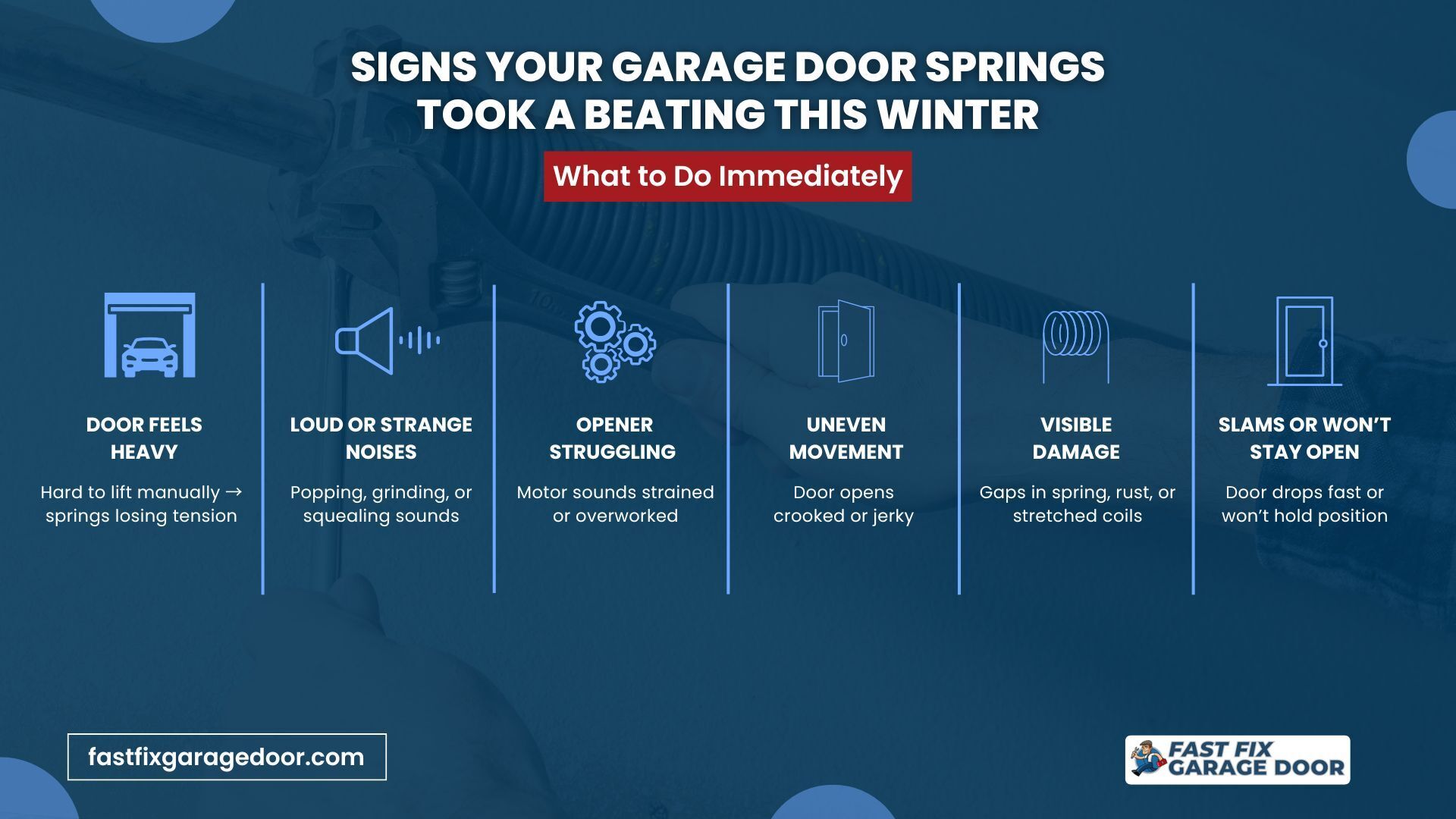
1. The Door Feels Heavy When You Lift It Manually
Here’s a quick test anyone can do safely. Pull the red emergency release cord (usually hanging from the opener rail) while the door is closed. Now try to lift the door by hand. A healthy door with strong springs should feel light. Around 10 pounds of effort. You should be able to lift it halfway and have it stay put on its own.
If it feels like you’re bench-pressing a car, or it slams back down the moment you let go, the springs have lost tension. They’re no longer balancing the weight of the door the way they should. The opener has been compensating for weeks or months, which puts extra strain on the motor and the chain.
2. Your Garage Door Opener Is Straining
If your opener used to hum smoothly and now it grinds, groans, or sounds like it’s working twice as hard, that’s another big clue. Openers aren’t designed to lift the full weight of a garage door on their own. They’re designed to assist springs that are doing the heavy lifting. When the springs weaken, the opener takes on work it wasn’t built for. Over a few weeks of that, the motor overheats and burns out.
A lot of homeowners call us, thinking they need a new opener. We get there, check the spring balance, and the real problem is the spring. Fix the spring, and the opener quiets right down.
3. The Door Is Uneven When It Opens or Closes
If your garage door opens crooked, leans to one side, or the top of the door lifts faster on one side than the other, one of your springs has weakened more than the other. Double-spring systems are designed to share the load evenly. When one loses tension, the other overworks, and the door tilts. Left alone, the stronger spring will eventually fail too, and when it does, you’ll often see the door come crashing down or stick halfway open.
Uneven movement is one of those issues that goes from “minor annoyance” to “stuck door” fast. If you notice it, don’t keep cycling the door. Every open and close adds more strain.
4. New Noises: Popping, Grinding, or Squealing
Your garage door should make a steady, familiar sound. After a while, you know what “normal” is. When the springs start to fail, the sound changes. You might hear:
- A sharp pop or bang as the door starts to move
- A grinding noise mid-lift
- A high-pitched squeal near the top
- A dull thud when the door closes
Each of these points refers to a different issue. Pops often mean cracked coils. Grinding usually means the rollers are fighting against poor tension. Squeals can be dry or rusted springs. Thuds on close almost always come from a spring that can’t hold the door back as it descends. None of these sound effects is cosmetic. They’re the door telling you something is wrong.
5. Visible Gaps, Rust, or a Spring That Looks Stretched
Sometimes you can see the problem without touching anything. Open the garage, look up at the torsion spring (the long metal coil mounted above the door), and inspect it carefully from a safe distance. Do not stand directly underneath. Look for:
- A visible gap in the middle of the coil, like the spring is split in two
- Heavy rust, especially orange or brown patches
- A spring that looks stretched longer than its partner
- Coils that are squeezed together in one spot and spaced out in another
Any of those visuals means the spring has either broken or is very close to it. Call a technician before you use the door again. Operating a door with a broken torsion spring can damage the opener, the cables, and even the panels.
6. The Safety Reverse Starts Acting Weird
Modern garage doors have a safety reverse that makes the door go back up if it hits something on the way down. When springs weaken, the opener’s weight sensors get confused. The door may reverse for no reason, stop halfway, or refuse to close at all. Homeowners often blame the sensors or the remote, but the root cause is usually tension on the door. Once the springs are adjusted or replaced, the reverse starts behaving normally again.
What You Should Do Next
Here’s a simple order of steps if you think your springs are on their way out:
- Stop using the door as much as possible until it’s checked.
- Pull the manual release and test the door by hand as described above.
- Look at the springs from a safe distance for any visible damage.
- Note the exact noises and behaviors so the technician knows what to look for.
- Call a qualified garage door repair company. Do not attempt to replace torsion springs yourself. They store enough energy to cause serious injury.
- Ask about replacing both springs at the same time, even if only one looks bad. They wear together.
- Schedule a full tune-up for the rollers, tracks, and opener while you’re at it.
- Set a reminder to lubricate the springs every six months with proper garage door lube, not WD-40.
That order of operations keeps you safe and keeps the repair cost reasonable.
Why DIY Spring Replacement Isn’t Worth the Risk
We get it. There are videos online, the parts are cheap, and the math looks easy. But torsion springs hold hundreds of pounds of stored tension. When something goes wrong during replacement, the winding bar can whip around fast enough to break bones or worse. Every experienced technician has heard a story. Most have seen at least one up close.
Beyond safety, there’s the issue of getting the tension right.
Springs that are over-wound wear out fast. Under-wound springs leave the opener doing too much work. Even if you survive the install, you may end up calling a technician anyway, a few months later. The small savings rarely hold up.
Why Spring in Particular Is the Right Time to Handle This
Winter damage shows up slowly. You might make it through February with a weakening spring and not notice anything dramatic. Then one cold morning in early spring, the door decides today is the day. We see a huge jump in emergency calls every March and April because of exactly this. Homeowners across Plano, Frisco, and the surrounding suburbs suddenly can’t get their cars out. The door is stuck half-open, the kids are late for school, and the repair costs more because it’s an emergency visit.
Getting ahead of the issue in early spring means you control the timing, the cost, and the convenience. A scheduled inspection takes about 30 minutes. A middle-of-the-workday emergency takes longer and costs more.
Wrapping Up
Your garage door works harder than almost anything else in your home, and the springs take the worst of it. A long winter makes that worse. If any of the signs above sound familiar, don’t wait for the big bang. A weakening spring almost always gives you warnings before it snaps, and catching it early saves you a chunk of money and a whole lot of stress.
When you’re ready to have someone take a look, we’re happy to come out, test the balance, and give you straight answers on what needs attention now versus what can wait. At Fast Fix Garage Door, we’d rather tell you your springs have another year in them than sell you something you don’t need. Give us a call when the timing feels right, and we’ll get your door quiet and moving right again.