
 fastfixoffice@yahoo.com
 Book Appointment
 Most garage door spring repairs last about 7 to 10 years under a standard 10,000-cycle rating, but in North Texas heat, that number often lands closer to 5 to 8 years. The reason is simple: springs are rated by cycles, not calendar years, and our Collin County climate speeds up metal fatigue. Summers that sit above 100 degrees, an unconditioned garage that swings 40 or more degrees in a single day, and hard winter freeze snaps all put extra stress on the steel. Families who use the garage as their main door burn through cycles faster, too. A high-cycle spring rated at 20,000 or more can double that service life if you use the door heavily.
What You’ll Walk Away With
By the time you finish reading, you will know how spring cycle ratings actually translate into years for a real Plano or McKinney home, not a generic national average. We will look at why the temperature inside your garage does more damage than the number on the thermostat outside, and why so many springs in our area seem to snap on the first cold morning of the year. You will also get a short checklist of early warning signs, honest cost ranges we quote around Collin County, and a clear answer on whether upgrading to a high-cycle spring is worth it for your household.
How Long Garage Door Springs Last, Measured In Cycles, Not Years
Here is the part most homeowners miss: a garage door spring is not rated to last a certain number of years. It is rated to survive a certain number of cycles. One cycle is the door going up once and coming down once. A standard torsion spring carries a 10,000-cycle rating, which manufacturers loosely translate into 7 to 10 years for an average family.
That translation only holds if your usage matches the “average.” Most estimates assume the door opens and closes about three to four times a day. Plenty of Collin County households blow past that without thinking about it.
Run the math on your own home. If four people leave and come back, plus a midday errand and an evening trip, you can hit 8 to 10 cycles a day fast. At that rate a 10,000-cycle spring is used up in under three years. Here is how the daily count changes the timeline:
| Cycles per day | How the door gets used | Standard 10k spring lasts |
| 2 to 3 | Second car, the garage is rarely the main entry | 9 to 12 years |
| 4 to 6 | Typical family, garage used daily | 5 to 7 years |
| 8 to 10 | The garage is the main door for teen drivers | 3 to 4 years |
| 12+ | Home business, multiple daily trips | Under 3 years |
These are working ranges, not guarantees. Door weight, spring quality, and maintenance all shift the number. But the pattern is real: the harder you use the door, the sooner the spring gives out, and no amount of calendar math changes that.
Why North Texas Heat Shortens Garage Door Spring Life
Texas heat is the second big factor, and it works on the steel in a few different ways at once. Torsion springs are wound steel under constant tension. Every time the temperature climbs and drops, the metal expands and contracts a little, and that repeated movement adds microscopic fatigue on top of the fatigue from cycling the door.
Industry sources put the effect at roughly 20 to 30 percent shorter spring life in hot climates compared to the rated lifespan. In practice around Collin County, that is why we so often replace springs at the 5-to-8-year mark instead of the textbook 7 to 10.
The garage temperature swing does the real damage
The number on your car’s thermostat is not the number that matters. What matters is the temperature inside the garage, right at the spring. Most garages across Frisco and the rest of Collin County are attached but unconditioned, with a single uninsulated door facing the sun for part of the day.
On a 102-degree July afternoon, an attached garage with a west-facing door can push well past that inside, then cool down overnight. That daily swing of 40 or more degrees is harder on the steel than a steady high temperature would be. Heat also thins out the lubricant on the coils faster, so the springs run drier and grind against themselves with more friction. Dry coils wear faster than greased ones, plain and simple.
Humidity and rust play a smaller part here
Coastal Texas towns like Houston fight heavy humidity that rusts springs from the outside in. Collin County is drier, so corrosion is a slower problem for us than it is on the Gulf. It still shows up on garages that back to a greenbelt or take regular lawn-sprinkler overspray, and rust between the coils raises friction the same way a dried-out lubricant does. If you see orange dust under the springs, that is steel wearing away.
This is also why we push a simple maintenance habit for our climate: a light coat of proper garage-door lubricant on the springs a couple of times a year, timed for spring and fall. Our summers cook off the grease faster than a milder climate would, so a garage that goes two or three years with dry springs is asking for early failure. It is a small step that will not undo the heat, but it does buy back some of the cycles the heat takes away.
The Winter Freeze Snap Most People Never See Coming
Here is the practitioner insight, the thing we see on the calendar every year that a national article will not tell you. Springs in North Texas break in clusters on the first hard cold morning of the season, not during the summer heat that weakened them.
We get slammed with broken-spring calls the morning after the first real freeze, and again during any hard snap like the ones the area saw in February 2021 and January 2024. The heat spends all summer fatiguing the steel. Then the temperature drops, the metal contracts and gets more brittle, and the extra load of a cold, stiff door is the final straw on a spring that was already 90 percent worn out. The cold does not cause the failure. It just collects the bill that summer ran up.
The takeaway is practical: if your door is a few years old and heading into fall, that is the smart window to have the springs checked, before a 20-degree morning finds the weak point for you and you are standing in the garage with a car you cannot get out.
Torsion Vs Extension Vs High-Cycle: What Actually Lasts Longer
Not every spring is built the same, and the type on your door changes how long it lasts.
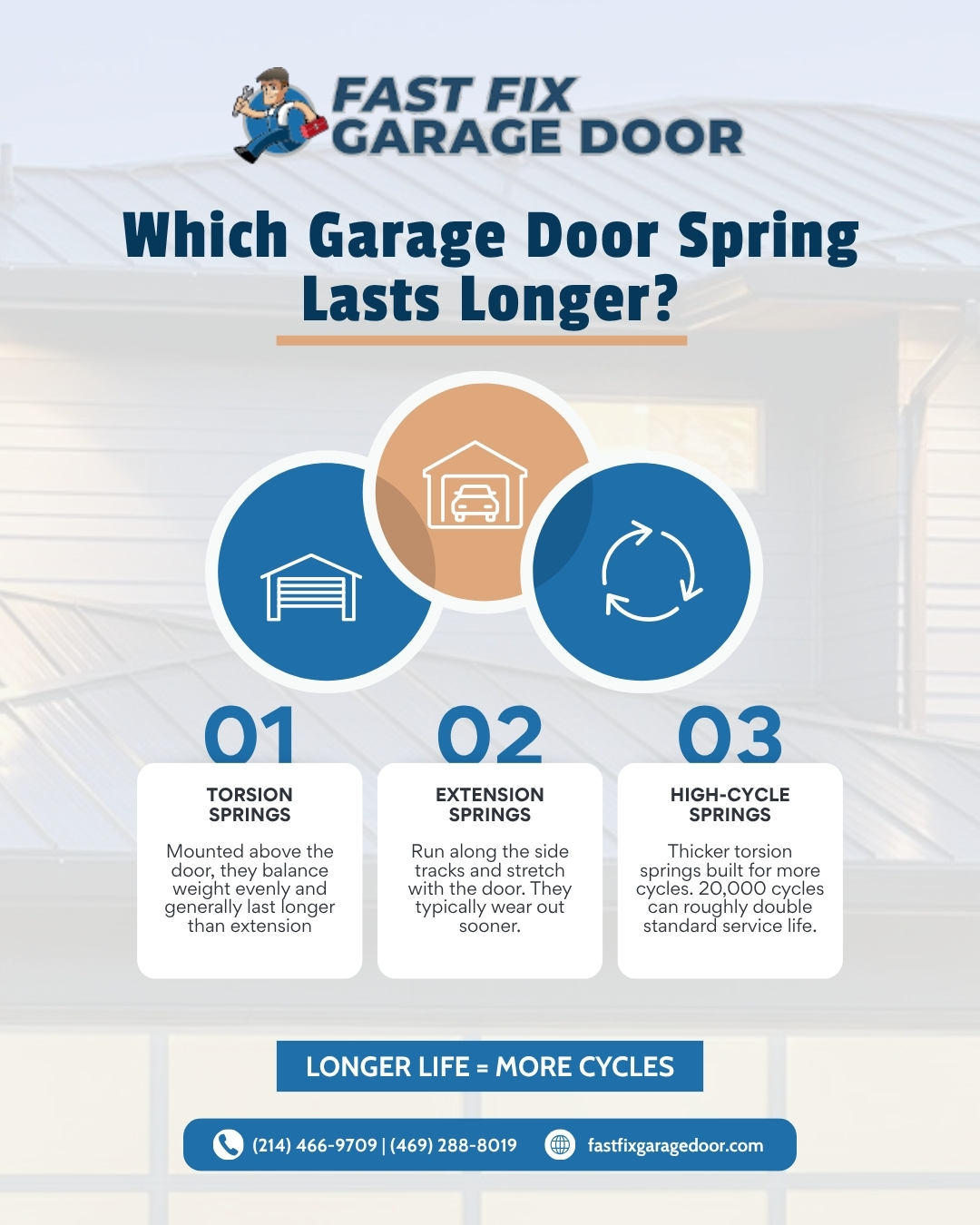
- Torsion springs mount on a bar above the door and are the more common, longer-lasting setup on modern doors. They handle weight more evenly and tend to outlast extension springs.
- Extension springs run along the tracks on each side and stretch as the door moves. They generally wear out sooner and are more likely to be found on older doors.
- High-cycle springs are simply thicker, longer torsion springs rated for more cycles. A 20,000-cycle spring roughly doubles the service life of a standard one, and 30,000-plus options exist for very heavy use.
For a household running 8 or more cycles a day, a high-cycle spring upgrade often makes sense. You pay somewhat more up front and replace the spring far less often. For a light-use second-car door, a standard spring is usually plenty, and the upgrade is money you do not need to spend. Weight matters here too. A heavier insulated steel or solid-wood door loads the spring harder on every cycle than a light single-layer door, so two homes with the same daily use can see different failure timelines based on what door they run.
One honest note on a broken garage door spring: replacing a single spring on a two-spring door is a short-term fix. If one snapped, the other is the same age and close behind. We almost always recommend replacing both at once so you are not paying for a second service call in a few months. It also keeps the tension balanced across the door, which protects the opener and the cables from taking uneven strain.
Early Warning Signs Your Springs Are Wearing Out
A worn spring usually warns you before it snaps. Catch it early, and you can schedule a repair on your terms instead of getting stuck with a car trapped inside. Watch for these:
- The door feels heavy or jerky when you lift it by hand with the opener disconnected.
- The opener strains, hesitates, or the door stops partway up.
- The door drops fast or slams the last foot or two instead of settling gently.
- You hear loud popping or grinding during operation.
- You can see a gap in the coils of the torsion spring, or the spring looks stretched.
- Orange rust dust has collected on the coils or on the floor below them.
If you spot a visible gap in the spring, treat that as already broken and stop using the door. A spring under that much tension is not something to test.
A quick word on safety, since it comes up on nearly every call. Torsion springs hold a serious amount of stored energy. A slipped winding bar can break bones. This is one job where garage door spring repair is genuinely worth handing to someone with the right bars and the training to use them, and it is why our techs treat spring work as the most hazardous part of the trade.
Two of these signs deserve extra attention because homeowners misread them. A door that suddenly feels heavy is often blamed on the opener, when the opener is fine, and the spring underneath it has lost tension. And a door that starts up, then stops and reverses, sends people looking at the photo-eye sensors when the real problem is a weakening spring the opener can no longer help lift. If you are unsure which it is, disconnect the opener with the manual release and lift the door by hand. A healthy spring makes the door feel nearly weightless and hold its position halfway up. A worn one makes it feel like dead weight or drops it to the floor.
What Spring Replacement Costs Around Collin County
Homeowners always want a real number, so here are the working ranges we see locally, labeled as ranges because every door is different. A standard torsion spring replacement commonly runs in the low hundreds per spring installed, and doing both springs together (which we usually recommend) lands higher than a single. High-cycle springs cost somewhat more up front for the longer service life.
Our own current spring special runs a set price for two torsion springs installed, and a tune-up that includes roller replacement and a full inspection runs less than that. Prices move with steel costs and door size, so treat any figure you read online, including these, as a starting point rather than a locked quote. A real number comes from someone looking at your specific door, spring size, and whether it is a one- or two-spring system.
When a spring problem is really a whole-door decision
Sometimes the cheaper spring is not the smart one. If a door is 20-plus years old, on its third set of springs, and the panels or rollers are worn too, we will tell you honestly that repeated spring repairs are throwing money at a door near the end of its life. In that case a new set of garage doors with high-cycle springs sized to the new door can cost less over the next decade than nursing the old one through failure after failure. That is a judgment call per door, not a rule, and we would rather quote you the honest version than sell you a spring that outlives the panels it hangs on.
Where to go from here
Springs are the one garage door part that wears out on a schedule you can predict, and North Texas heat only tightens that schedule. If your door is pushing past five years, feels heavier than it used to, or is heading into its first fall since the last replacement, a quick inspection now beats a broken spring on a freezing morning. When you are ready for a look or a repair, Fast Fix Garage Door serves Plano, McKinney, Frisco, Allen, Prosper, Wylie, and Celina, and we can tell you honestly whether a standard or high-cycle spring fits how you actually use your door.