
 fastfixoffice@yahoo.com
 Book Appointment
 TL;DR
A garage door that will not close is almost always the photo-eye safety sensors doing what they were built to do. Check for anything sitting in the opening, wipe both sensor lenses, and confirm both indicator lights are on and steady. Sensors sit no higher than six inches above the floor, facing each other across the opening, and a small bump to one bracket breaks the beam.
Track debris and low evening sunlight cause the same symptom. Stop at the balance test: if the door will not hold itself partway open by hand, the spring system is involved, and torsion springs are not a homeowner repair.
A Door That Refuses to Close Is Doing Its Job
Your opener has two separate ways of noticing that something is under the door, and the federal standard at 16 CFR part 1211 requires both on residential units. The first is contact-based: section 1211.7(b)(1)(i) says the operator “shall initiate reversal of the door within 2 seconds of contact with the obstruction.” The second never touches anything. Section 1211.8(a)(1) calls for an external device, either a photoelectric sensor or an edge sensor mounted along the bottom of the door.
That second layer is the one you see: two small plastic eyes bolted low on the vertical tracks, one on each side of the opening, wired back to the opener head.
The Consumer Product Safety Commission explains why it exists. Its safety alert on non-reversing openers, publication 523, reports that about 73 children between the ages of 2 and 14 have been trapped and killed under automatic garage doors since March 1982, roughly three a year, with others left with brain damage or serious injury when a door hit them and did not reverse. The agency notes that reversing systems became mandatory for openers manufactured or imported after January 1, 1991, and that “a requirement for an external entrapment protection system was added in 1993.”
Here is the part homeowners miss. When the opener cannot confirm a clear opening, it does not guess. It refuses to close under normal control. The failure in front of you is a sensor circuit reporting a problem, and that circuit is far more likely to be wrong than the door is to be dangerous.
None of this is frozen in 1993 either. The Commission published a direct final rule at 89 FR 18538 on March 14, 2024, effective May 13, 2024, folding the February 21, 2023 revision of UL 325’s Seventh Edition into part 1211, including a rule that edge sensors actuate at 15 lbf or less.
What Is Your Door Actually Doing Right Now?
Four symptoms point to four different systems, and naming yours before you touch anything saves most of the ten minutes.
A door that starts down and rides all the way back up is the entrapment protection tripping. A door that will not move at all points to power, the lock feature, or the drive. A door that stops partway is mechanical. A door that only closes while you hold the wall button is telling you the external sensor circuit is out.
| What the door does | What it points at |
| Starts down, reverses fully back up | Photo eye beam broken, or the door contacted something |
| Nothing happens, or the motor hums and the door stays put | Power, the lock or vacation feature, a disconnected trolley, a broken spring |
| Runs down partway, stops or binds | Track debris, a damaged roller, a travel limit set wrong |
| Closes only while the wall button is held down | External entrapment protection is inoperative |
That last row is worth sitting with. The Door and Access Systems Manufacturers Association describes the intended behaviour plainly in its Automatic Garage Door Opener Safety and Maintenance Guide: with the photoelectric sensor blocked, “the door should not close unless the wall-mounted push button is manually held during operation.” Constant contact is the deliberate fallback. If holding the button is the only thing that works, you have already diagnosed the sensors.
Minutes One to Three, Spent Looking Down the Opening
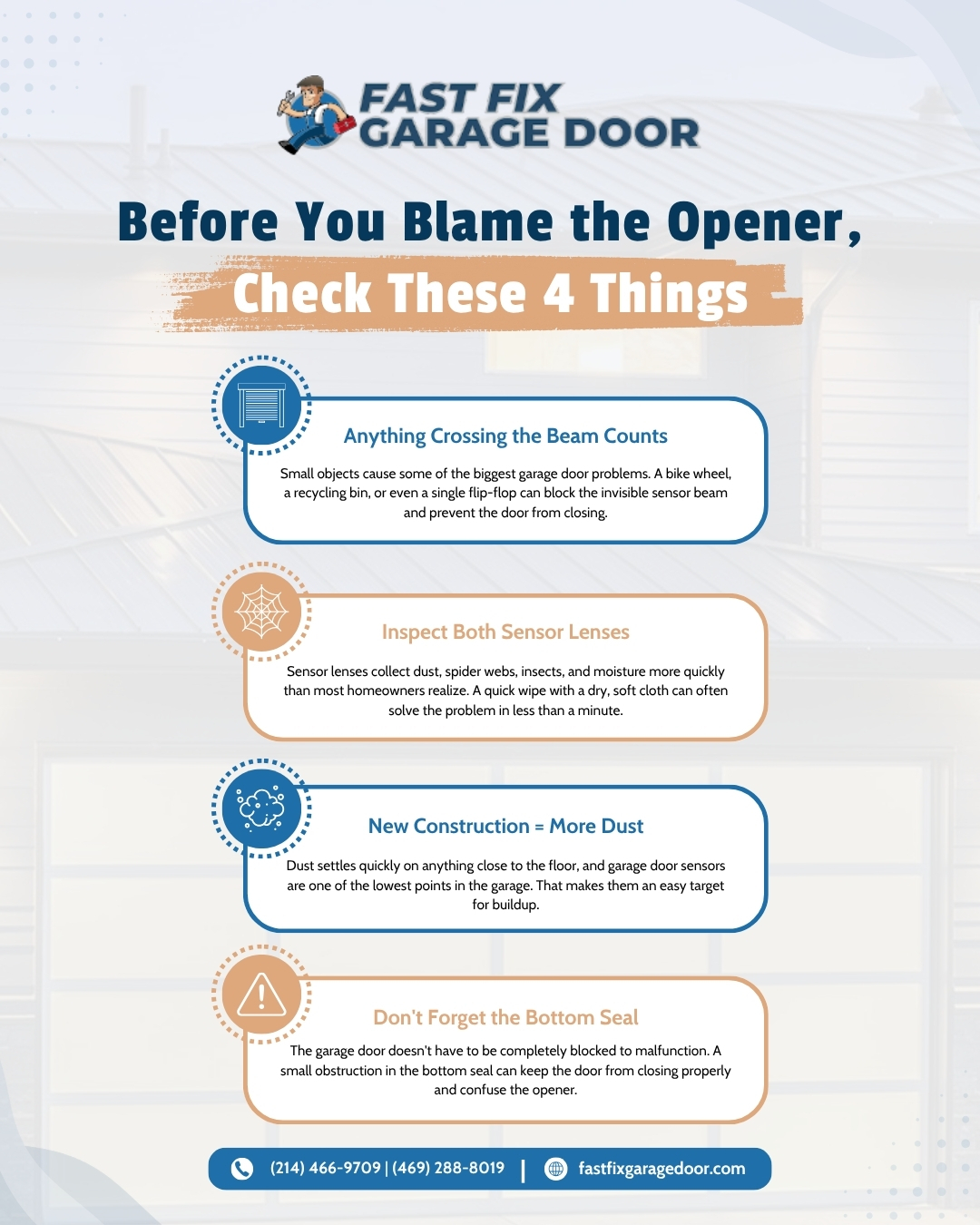
Stand outside and look along the floor line. The objects that break the beam are rarely obvious from the car: a bike wheel parked an inch too far left, a bag of mulch that slumped sideways, a recycling bin lid, a flip-flop. Anything crossing the invisible line between the two eyes counts, and that line runs the full width of the opening.
Then look at the lenses. A spider web spun overnight across one eye is enough. So is a film of dust, a dead insect wedged in the housing, or condensation on a humid morning. Wipe both with a dry, soft cloth; no solvent.
Newer construction has its own version of this. In the subdivisions still going up around Celina and Prosper, fine grading dust settles on everything low to the ground. The sensor lens is about as low as anything in a garage gets.
Check the bottom seal too. A pebble caught in the rubber holds the door a fraction open, which is enough for the opener to decide the travel is wrong.
The Two Small Lights and What They Are Telling You
Every photo eye pair has indicator LEDs, and reading them takes about thirty seconds once you know which is which.
Where the sensors are supposed to sit
DASMA Technical Data Sheet 364, last revised August 2020, sets the geometry. Each photoelectric eye lens “is to be installed to emit a photoelectric beam no higher than six (6) inches above the garage floor.” The pair are “usually located up to 20 feet apart” and should sit “within six (6) inches of the path of the door measured perpendicular to the door.” CPSC puts the same figure as a range, calling for the electric eye at a height of 4 to 6 inches above the floor. If one of yours has been pushed up to knee height by somebody storing bins against the track, that is a finding.
Reading the pair
One unit sends the beam and one receives it. Both should show a light, and both should be steady. A receiving light that is off, or flickering in and out, means the beam is not landing cleanly on the lens. That is aim, dirt, or wiring, in that order of likelihood.
Nudging one back into line
Loosen the wing nut or the bracket screw just enough that the sensor moves with finger pressure. Tilt it in very small increments while watching the light. When it glows steady rather than flickering, hold it there and snug the fastener back down without letting the housing rotate. Then run the door.
Brackets get knocked out of aim by ordinary garage life. A car door swung too wide will do it, and a bike parked against the bracket all summer does it slowly.
When aim is not the problem
Follow the wire. The runs are thin, stapled along framing, and they fail where something has crossed them. Look for a staple driven through insulation, a nick where the wire passes a track bolt, or a stretch chewed by rodents. A shorted or reversed pair reads to the opener exactly like a blocked beam.
Why Does This Only Happen in the Evening?
Because sunlight carries infrared, and so does your sensor beam. When low sun shines straight into the receiving lens, it drowns out the signal from the sending unit, and the opener behaves as though something is standing in the doorway. Chamberlain, which builds LiftMaster openers, states it directly in its own support documentation: “Sunlight can cause interference with the safety sensors, causing the operator to act as if the sensors are blocked.”
Their two fixes are worth knowing before you buy anything. Swap the sensors to the opposite sides of the opening so the receiver faces away from the sun, or fit a sun shield, which Chamberlain sells as part number 41B873. Swapping alone can be temporary, since the sun eventually comes around to the other side.
The timing is what makes this so easy to misdiagnose in Collin County right now. According to the US Naval Observatory’s rise and set data, sunset in Plano falls at 8:12 pm on August 15, 2026, and moves up to 7:33 pm by September 15. Through late summer and early fall, the sun sits low in the western sky during exactly the window when people are pulling into the driveway. A west-facing garage in Plano or Frisco gets the beam washed out for perhaps half an hour, then works perfectly once the sun drops behind the neighbour’s roofline.
That is why the door “fixes itself” and why a service call booked for ten the next morning finds nothing wrong. If the fault is only ever in the evening, write down the time it happens before you call anyone.
Walking the Tracks Without Making Things Worse
Run your eye up both vertical tracks with the door open. You are looking for four things: debris sitting in the channel, a dent or flat spot in the metal, a lag bolt or bracket that has backed away from the framing, and a roller riding up on the lip of the track instead of sitting in it.
Small debris in the channel is fair game. Pull the leaf, the pebble, or the chunk of dried mud out with the door fully open and the opener disconnected, and stay out from under the door while you do it.
Everything else on that list is where the homeowner checklist stops. Do not hammer a bent track flat, and do not run the opener repeatedly to seat a door that is riding badly. A door that is even slightly off track puts the load somewhere the hardware was never meant to carry it, and forcing it is how a bad afternoon becomes a bent panel and a torn header bracket. Search demand across Plano, McKinney, Frisco, The Colony, and Little Elm for off-track doors runs high enough every month that we would rather say this plainly than politely.
Give the lift cables a look while you are there. On each side, a cable runs from the bottom bracket up to a drum at the top. If one hangs slack or has jumped its drum, the door’s weight is being carried unevenly, and the opener will fight it.
Minute Ten, the Balance Test, and the Line We Do Not Cross
DASMA’s maintenance guide gives the test, and we use the same one. Close the door, pull the manual release cord to disconnect it from the opener, then lift it by hand. It should move freely, and it should “balance and stay partially open 3 to 4 feet above the floor.” CPSC describes the same condition from the other direction: a properly operating door “will stay in place when stopped in any partially-open position.”
If the door drops when you let go, or pulls itself up out of your hands, the spring system is out of balance. That result ends the checklist. It is also the most common reason a door that seems like a sensor problem turns out not to be one, because an opener straining against an unbalanced door will hit its force limit and reverse partway down, which looks identical to a beam break from inside the car.
Torsion springs sit in a tube above the opening, holding the entire weight of the door in wound steel. The same DASMA guide carries the warning in capitals: springs are under high tension, and only qualified individuals should adjust them.
There is no version of that job with a good outcome for someone without winding bars and the training to use them, which is why this is the point where a two-minute fix becomes an emergency garage door repair call instead. If the coil has a visible gap or is sitting in two pieces, what a broken spring looks like from the inside covers what happens next. Springs also age on a cycle count rather than a calendar, and heat shortens that count in North Texas garages.
Two things make this test go wrong for people, so do them in order. Run the release with the door closed, never with it open, because a door disconnected at the top of its travel has nothing holding it up but the springs you are about to test. And lift from the handle or a solid stile, not from a panel joint, since fingers in a joint are how the other common garage injury happens.
An unbalanced door also fails in a way you can hear. Listen at the halfway point on a normal cycle. A door fighting a weak spring gets noticeably louder as it passes the middle of its travel, because that is where the spring is doing the least work and the opener is making up the difference. Combine that with a door that will not hold at chest height by hand, and you have your answer before anybody looks at a sensor.
While the door is disconnected, get in the habit of the monthly test both CPSC and DASMA ask for. CPSC recommends inspecting the door and opener every 30 days, and its list is short: look for wear on hinges, rollers, and panels, check the springs and fittings, and confirm the door is balanced.
DASMA’s sensor test takes about fifteen seconds. Start the door moving down, wave something through the beam, and confirm the door reverses and returns fully open. Doing that once a month is also how you catch a sensor drifting out of aim before it strands you in the driveway on a Friday night.
Findings That Cancel the Rest of the Checklist
Some findings end the ten minutes at second thirty. Stop where you are and call if you see any of these.
- A visible gap in a spring coil, or a spring sitting in two pieces.
- A door hanging crooked, with one side clearly higher than the other.
- A lift cable hanging loose, off its drum, or frayed.
- A buckled or creased panel where a bumper found it.
- Water pooled near the opener wiring after a storm.
- A motor that runs while the door stays put, which is a stripped drive gear or a parted trolley rather than an opener setting.
One more, and it is not mechanical: a vehicle trapped inside with no other way out is urgent no matter what the door is doing.
When Your Ten Minutes Are Up, and the Door Is Still Open
Write down what you found before you call, because it changes what we bring. The symptom pattern, whether both sensor lights were steady, whether it only happens at a particular time of day, and what the balance test did are the four things that let us load the right parts on the truck instead of making two trips. If the door is stuck open, disconnect the opener and close the door by hand if it will move safely, then leave it disconnected.
We cover Collin County and the surrounding towns, including Plano and McKinney, and most stuck door calls turn out to be sensors, tracks, or springs in that order. Tell Fast Fix Garage Door what your ten minutes turned up, and we will tell you honestly whether it needs a truck.