
 fastfixoffice@yahoo.com

 Book Appointment
Find the manufacture date on the motor unit before you approve any repair. If the opener was built before 1993, replace it: it predates the federal entrapment protection rule, and at least one major maker stopped selling parts for its units of that age years ago. If it was built in 1993 or later, a single failed part is usually worth fixing, provided the door itself is balanced.
TL;DR
The garage door opener repair vs. replace decision starts with the manufacture date printed on the motor unit. A garage door opener built before January 1, 1993 predates the federal safety standard, 16 CFR part 1211, which requires a second layer of entrapment protection such as photo eyes. Genie has not supported repair of its own pre-1993 openers since July 1, 2013. Replace those. A garage door opener built in 1993 or later is usually worth a repair when the fault is one part, and the door stays put when stopped halfway. Census estimates put 40.0 percent of Plano housing units before 1990, against 4.8 percent in Frisco and 3.7 percent in Prosper, so the date question comes up most in older Plano, Allen and McKinney neighborhoods.
Where Is the Manufacture Date on a Garage Door Opener?
The date is on the motor unit itself, the box on the ceiling or beside the door on a wall-mount model, on the same label as the maker’s name and model number. The federal standard, 16 CFR part 1211, says an opener must be plainly marked with the manufacturer’s name, a catalog number, and the date of manufacture, somewhere that stays visible after installation. In practice, that often means under the light lens or on the back panel.
Three things help when you read it.
- It may be a code: The rule allows the date to be “abbreviated or in an established or otherwise accepted code.” If you see a string of letters and digits instead of a month and year, copy the brand, the model number, and the whole serial string. That is usually enough to pin down the year.
- A plain date is required from 1991 on: The same standard says a unit made on or after January 1, 1991 must show the month or week and the year it was manufactured.
- No date at all is an answer too: Either the label has come off, or the unit is older than the date-marking requirement. Treat it as old until something proves otherwise.
There is also a check that needs no ladder. Look at the bottom of the door tracks on both sides for a pair of small sensors facing each other across the opening. No sensors is a strong hint that the opener predates 1993.
Three Dates That Sort Every Opener
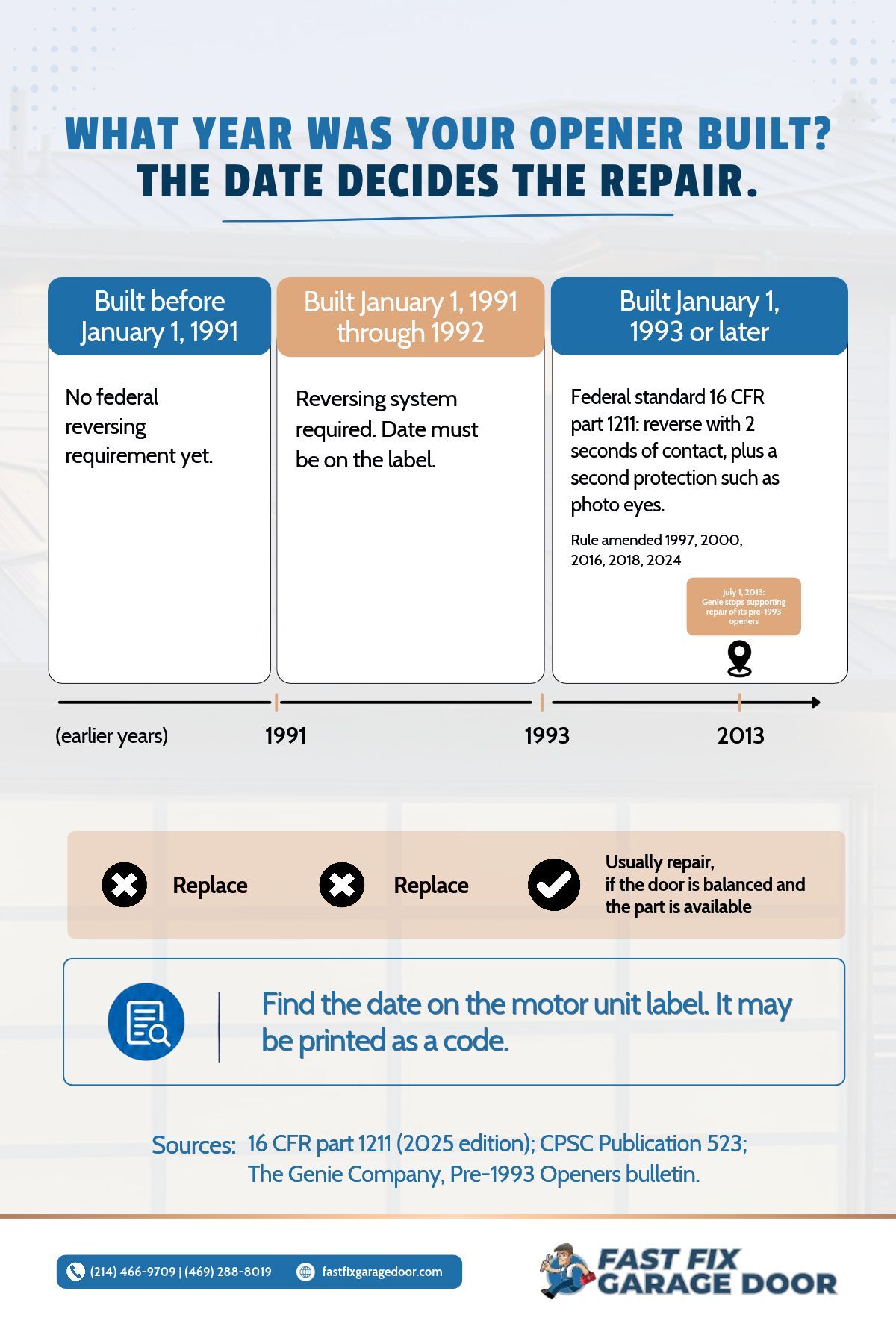
Once you have the year, the decision gets short. Federal rules for these machines changed twice, two years apart, and which side of each line your unit sits on matters more than which part has failed.
| Built | What federal rules required when it was new | Our read on paying for a repair |
|---|---|---|
| Before January 1, 1991 | No federal reversing requirement applied yet | Replace it. Do not buy parts |
| January 1, 1991 through 1992 | A reversing system, and a date on the label | Replace it. No second layer of protection was required |
| January 1, 1993 or later | The 16 CFR part 1211 standard: reversal within 2 seconds of contact, plus a second form of entrapment protection | Usually repair, if the door is balanced and the part can still be ordered |
Built before 1991
The Consumer Product Safety Commission’s safety alert on non-reversing openers states that the agency requires every garage door opener manufactured or imported for sale in the United States after January 1, 1991, to have a reversing system. A unit older than that may have been sold without one. It can come down on something and keep pushing.
The alert gives the reason in one number. According to reports the commission had received, about 73 children between the ages of 2 and 14 were trapped and killed under automatic garage doors after March 1982, about three a year on average.
The first item on its list for homeowners is to replace older openers with reversing units that meet the federal standard.
Built in 1991 or 1992
These two years are the gap. A unit from this window had to reverse when the door met resistance, but the same alert notes that the requirement for an external entrapment protection system was added in 1993. So a 1992 opener has to touch whatever is under the door before it reacts.
Same verdict as the older group. It runs, and that is not a reason to put money into it.
A practical note on this window. A 1991 or 1992 unit is the first that had to carry a readable month or week and year, so it is also the easiest old opener to identify with certainty. If the label says 1992, you do not need a second opinion.
Built in 1993 or later
The standard’s first line says it applies to “all residential garage door operators manufactured on or after January 1, 1993 for sale in the United States.” From here on, age alone is not what decides a repair. Condition and parts are.
What Does the 1993 Federal Rule Require?
It requires two layers of protection, not one. First, a closing door that contacts an obstruction must begin to reverse within 2 seconds. Second, the opener needs one more safeguard on top of that: an external photoelectric sensor (the photo eyes), a sensing edge on the bottom of the door, or a control that only lowers the door while someone holds the button and can see the opening.
As the rule reads today, the opener also has to check that its sensor is present and working at least once in every close cycle. If the sensor is missing or faulted, a closing door must open again, and an open door may not close more than 1 foot below its top position.
That one clause explains a very common “broken opener” call. The door starts down, stops, and climbs back up, and nothing looks wrong. Under the standard, that is the opener doing its job because it cannot confirm the photo eyes. Our own service page lists safety sensors knocked out of line as one of the simple opener problems, and it is a repair, never a reason to buy a new unit.
A few other requirements are easy to spot on a compliant opener:
- A manual release with a red handle, so the door can be detached from the opener by hand.
- A warning label, near the adjustment controls, saying the door must reverse on a 1 1/2 inch obstruction or a 2 by 4 board laid flat.
- A caution label about entrapment meant to be fixed beside the wall button.
The edition of the rule we read lists amendments in 1997, 2000, 2016, 2018, and 2024. A 1995 unit and a 2020 unit were not built to identical text. Both still sit on the right side of the line that matters here.
Rule Out the Door Before Blaming the Motor
An opener is built to move a door that the springs have already made light. When the door is out of balance, the motor takes the load, and the symptoms look exactly like a dying opener: straining, stopping partway, reversing for no visible reason.
The CPSC alert describes a properly operating door as balanced, meaning it stays in place when stopped in any partially open position. Its own check is simple and involves no tools.
- Close the door fully.
- Pull the release handle to detach the door from the opener.
- Raise the door by hand to about waist height and ease your grip.
- A door that stays where you left it is balanced. One that drops, drifts up, binds or takes real effort to move is not.
If it fails, stop there. The commission’s advice is that a door which is out of balance, or which binds or sticks, should be serviced by a trained technician. Springs and cables hold the tension that makes the door liftable, and the warning on our services page says only qualified individuals should adjust them. We mean it.
This is the step that changes the most quotes. A new motor on an unbalanced door only moves the failure downstream, and a door that binds because one section is bent is a different job again, covered in our piece on whether a single damaged section can be swapped.
Which Opener Faults Are Worth Fixing?
On a unit built in 1993 or later, hung on a balanced door, most single-part faults are worth fixing. The picture changes when the part is no longer supplied, or when it is the second major failure on an aging unit.
| What is wrong | Unit built 1993 or later | Unit built before 1993 |
|---|---|---|
| Photo eyes knocked out of line, or their wiring damaged | Repair | Most have no photo eyes to fix |
| Worn gear and sprocket | Repair. It is a wear part | Replace the opener |
| Failed circuit board | Depends on the unit’s age and whether the board can still be ordered | Replace the opener |
| Door will not reverse on a 2 by 4 laid flat | Adjust or repair, then retest | Replace the opener |
Parts supply is where age bites even on the right side of 1993, and it is the one thing no technician can fix. The clearest written policy we know of is Genie’s bulletin on pre-1993 openers. Effective July 1, 2013, the company stopped supporting repair of all pre-1993 Genie garage door openers, including technical service support and the sale of replacement parts.
Genie’s wording goes further than a parts cutoff. The bulletin says the vast majority of those older units have no infrared sensors or other external entrapment protection, and that the company will not be responsible for warranty or liabilities when someone repairs one. When the manufacturer itself declines to stand behind a repair, we would not ask you to pay for it.
For everything newer, we handle garage door opener repair on any brand, including units we did not sell.
Is it cheaper to repair or replace?
Honestly, it depends on which part failed, and we will not print a repair figure that could be wrong for your unit. What we can give you is the pattern. One wear part on a mid-life opener is nearly always the cheaper route. A failing board on a chain unit around twenty years old is the case where full replacement is usually the smarter money than repairing it piece by piece.
If you want numbers for the replacement side of the comparison, the unit price ranges by drive type are in our belt chain and screw drive comparison.
How Old Is the Opener Likely to Be in Your Part of Collin County?
It depends heavily on the city, because the houses were built in different decades. The Census Bureau’s American Community Survey five-year estimates for 2020 to 2024 (table B25034, year structure built) show how far apart five of the towns we serve really are.
| City | Housing units (estimate) | Built before 1990 | Built 1990 to 1999 | Built 2000 to 2009 | Built 2010 or later |
|---|---|---|---|---|---|
| Plano | 117,686 | 40.0% | 28.6% | 17.6% | 13.7% |
| Allen | 39,094 | 17.2% | 23.3% | 32.9% | 26.7% |
| McKinney | 77,617 | 12.3% | 14.9% | 33.2% | 39.6% |
| Frisco | 80,353 | 4.8% | 13.7% | 34.8% | 46.7% |
| Prosper | 11,921 | 3.7% | 3.2% | 20.9% | 72.1% |
Plano is where the year question is live. The survey estimates 47,112 Plano housing units were built before 1990, and any opener original to one of those garages was made before the 1993 line. Plenty of those garages have had a newer unit fitted since. The census cannot say how many, which is why the label matters more than the age of the house.
Frisco and Prosper are the opposite case. Almost nothing there predates 1990, so a pre-1993 opener should be rare. The question in those towns is wear: a home built between 2000 and 2009 that still has its first opener is running a unit 17 to 26 years old this year.
McKinney is both at once. The same table counts 1,128 McKinney units built in 1939 or earlier, alongside 39.6 percent built since 2010.
Two cautions on reading the table. These are survey estimates with margins of error, and they count every kind of housing unit, apartments included. They date the home, not the machine on the garage ceiling.
We work both ends of that range, from garage door service in Frisco, where a builder-installed unit from the 2000s may still be the original, to the older streets of Allen, where about one housing unit in six was built before 1990.
What a Replacement Visit Should Include
More than a motor swap. This is what ours covers.
- Checking that the door is balanced before anything is quoted.
- Resetting the travel and force limits, so the door stops in the right places and reverses when it should.
- Testing the photo eyes and confirming the door reverses when the beam is broken.
- Pairing the wall button and the remotes.
We keep three LiftMaster models on hand: a belt drive, a chain drive, and a wall-mount unit with battery backup. All three have built-in Wi-Fi. Already bought an opener somewhere else? We install almost any brand or model.
A caution about phone control. A small add-on device can give a fairly new opener the same feature, as we explain in our guide to smart openers. It does nothing for a 1989 unit.
Read the Opener Label, Then Call With the Date in Hand
Before you agree to a repair, get three facts. The brand and model number. The manufacture date, or the serial string if the date is in code. And whether there are photo eyes at the bottom of the tracks.
With those in hand, the conversation is short. A pre-1993 unit gets replaced. A newer unit with one failed part and a balanced door usually gets repaired. Everything in between comes down to whether the part is still made and what else on the door is worn.
We are based in McKinney and have served Collin County since 2007. Call Fast Fix Garage Door with the date off the label, and we will tell you which side of the line your opener is on before anyone orders a part.