
 fastfixoffice@yahoo.com
 Book Appointment
 Yes, you can often replace one garage door panel without buying a whole new door, but only when three things line up: the manufacturer still makes that exact model, the damage stays inside one section, and the section is not carrying hardware that has been bent along with it. Where the dent sits matters as much as how big it is. The bottom section is a different job from the one in the middle.
TL;DR
A single dented or cracked section on a sectional garage door can usually be replaced on its own, provided the door’s maker and model can be identified, and that model is still in production. The position of the damage changes the work: the bottom section carries the lift cables and is under spring tension, and the top section usually carries the opener bracket. After a hailstorm in Collin County, Rockwall County, or the Dallas County suburbs, the repair often costs less than a percentage of the insurance deductible, so a claim may pay nothing. Texas law also requires the policyholder to pay the deductible, and a seller who offers to waive it commits an offense. When several sections are damaged, or the model is discontinued, a new door is usually the honest answer.
Can You Replace Just One Garage Door Panel?
In most cases, yes. A sectional door is built as four or five horizontal sections hinged together, and each one can be unbolted and swapped for a matching section from the same maker. The catch is the word matching. Garage doors look alike from the curb and are not alike at all underneath.
That is why the first thing we ask for is not a photo of the dent. It is the name of the company that built the door.
We say this on our own service pages, and it holds on every job: to replace a section, we first need to establish who made the door and the model number, and then find out whether that section is still available. Some manufacturers have discontinued models. Some are no longer in business. When either is true, the single-panel option closes before anyone quotes a price.
A dent is also sometimes repairable without a new section at all, depending on the damage. A shallow crease in a steel skin is a different problem from a split stile or a section that has folded at a hinge line.
Where the Damage Sits Changes the Whole Job
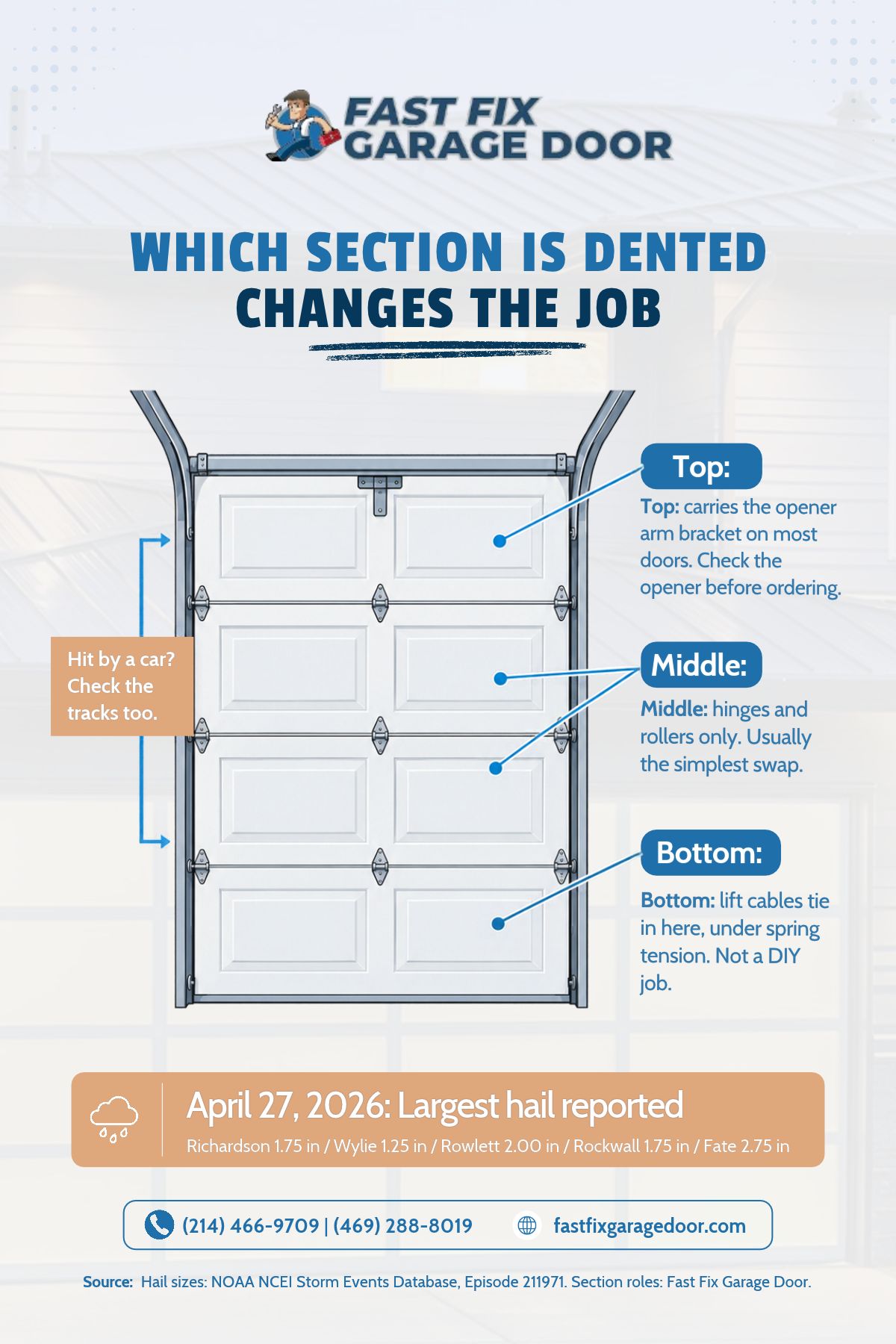
Two dents of the same size can be very different repairs because the sections are not interchangeable in what they carry. Here is how we read a door from the driveway, top to bottom.
| Section | What is attached to it | What a dent here means |
|---|---|---|
| Top | The opener arm bracket on most doors, plus the top fixtures that hold the door against the header | A bent top section can pull the opener out of line, so we check the arm and the bracket before ordering anything |
| Middle (one or two) | Hinges and rollers only | The simplest swap. This is the section most likely to be a straightforward replacement |
| Bottom | The bottom brackets, the lift cables and the bottom weather seal | The lift cables tie into this section and the springs are pulling on them. Not a job to start with a socket set |
| Any section, hit by a car | Whatever the impact bent: hinges, rollers, often the track | We look at the tracks as closely as the panel, because a door that has been hit often comes off track too |
Why the bottom section is the one to leave alone
On a torsion system, the cables attached to each side of the lowest panel are what the springs pull on to lift the door. That tension is there whether the door is moving or not. Unbolting the bottom brackets without first releasing it lets the stored energy go wherever it wants, which is the same reason we tell people never to adjust springs themselves.
If your dent is on the bottom section, the safest thing you can do is leave the door closed, pull the opener’s plug, and call.
A backed-into door is usually more than one problem
Our own experience with smashed doors in Plano, McKinney, and Frisco is consistent. A garage door rarely comes off track by itself; when it does, something was in the way, the springs were weak, or the door was hit. A car strike bends the section and often the track and hinges beside it, so the quote for “one panel” frequently grows once the door is open and the track is checked.
The Four Things We Need Before Ordering a Section
A replacement section is ordered, not pulled off a shelf, so the order has to be right the first time. This is the checklist we work through, in order.
- The manufacturer: Usually printed on a label on the inside of the door, often on an end stile or the bottom section. A door with no label can sometimes be identified from its hinge numbers and section profile, and sometimes cannot.
- The model and design: Raised panel, flush, carriage-house pattern, long or short panel. Two doors from one maker can share a color and still have different embossing, and a mismatched pattern is obvious from across the street.
- The size and construction: Door width, section height, and whether the section is single-layer steel, steel with an insulation backer, or a bonded sandwich. A thicker insulated section will not sit correctly between two thinner ones.
- Availability: Whether the maker still produces that section, in that width, in that color. This is the question that ends more single-panel repairs than any other.
The color problem nobody warns you about
Even when the part number matches perfectly, a new section is new. A door that has faced west through several North Texas summers has had years of sun on it, and the replacement has had none.
For a white door, the difference can be small. For a darker color, or a woodgrain finish, it can be obvious, and the practical fix is painting the whole door so every section weathers together from the same day. Ask about that before you approve the order, not after the section is hung.
What Did the April 27 Hailstorm Leave Behind?
On the evening of April 27, 2026, a line of storms dropped hail across the eastern half of our service area in a little over an hour, according to the NOAA Storm Events Database kept by the National Centers for Environmental Information. The reports ran from Richardson through Murphy and Wylie, into Rowlett, and on to Rockwall and Fate.
That record is useful to a homeowner for a plain reason. It is a dated, public, third-party account of hail at your town on a specific night, and it is exactly the kind of thing an adjuster or a contractor can check.
| Town | County | Largest hail reported that evening |
|---|---|---|
| Richardson | Dallas | 1.75 inches |
| Murphy | Collin | 1.00 inch |
| Wylie | Collin | 1.25 inches |
| Rowlett | Rockwall | 2.00 inches |
| Rockwall | Rockwall | 1.75 inches |
| Fate | Rockwall | 2.75 inches |
The report filed from Fate noted hail large enough to leave holes in a metal roof near a grocery store. The same storm system had been producing daily storms since April 24, according to the database’s own narrative of the episode.
It was not a one-off. The database holds 156 hail reports in Collin County on 40 separate days between January 2021 and June 2026, and 28 in Rockwall County on 10 days, in the files NOAA published this month. For a steel garage door on a north- or east-facing Collin County house, a dented section is a when question more than an if question.
Checking your own street
The database can be searched by county and date range. If a section on your door was dented during a storm, look up the date and your county and save the page. It takes a few minutes, and it answers the first question anyone will ask: was there hail here that day?
Is a Dented Panel Worth an Insurance Claim in Texas?
Often it is not, and the reason is the deductible. The Texas Department of Insurance explains on its deductibles page that a deductible can be a set dollar figure or a percentage of the home’s insured value, and that wind and hail deductibles are often higher than the one for other damage. Its own worked example is a home insured for $150,000 with a 5 percent deductible, which is $7,500: a $6,500 hail repair on that policy is paid entirely by the homeowner.
A single garage door section on an otherwise sound door is a small repair. On a percentage deductible, it will very often land under the line.
The department adds one more caution in that guidance. Filing small claims may affect how much you pay for insurance later.
Where a claim does make sense is when the door is one item among several from the same storm: roof, gutters, fence, a car. Then the garage door section becomes a line in a larger claim, and the deductible is applied once.
What Texas law says about your deductible
Texas settled this in statute in 2019. Insurance Code section 707.002 says a person insured under a property insurance policy “shall pay any deductible applicable to a first-party claim made under the policy.” Section 707.004 in the same chapter lets an insurer hold back replacement cost payments until it receives reasonable proof that you paid it.
The other half sits in the Business and Commerce Code. Section 27.02 makes it an offense, a Class B misdemeanor, for a seller to advertise or provide work paid from a claim while paying, waiving or rebating the insured’s deductible without the insurer’s consent. A contract of $1,000 or more expected to be paid from a claim must print a notice saying so in 12-point bold type.
So if anyone after a hailstorm offers to “take care of your deductible” on a garage door, a roof or anything else, they are offering to break a Texas law, and the proof-of-payment rule means the arrangement can come back to you. We quote the repair, and you pay the deductible.
When One Panel Turns Into a New Door
Sometimes the single-section repair is the wrong money to spend. This is the point where we would tell you so, and these are the signals.
- Damage across two or more sections, especially from hail, which rarely picks one.
- The maker or the model is discontinued, so no matching section exists.
- The door is old enough that springs, rollers, and cables are also near the end of their life, so the section would be new hardware hung on worn parts.
- The section is folded or split at a hinge line rather than dented in the face.
- The door is a one-piece tilt-up rather than a sectional, which has no sections to swap.
If two of those apply, read our longer piece on deciding between repair and replacement before approving anything. The age of the door and its repair history carry as much weight as the dent.
A new door also resolves the color question, since every section starts weathering on the same day.
What to Photograph Before Anyone Touches It
Ten minutes with a phone shortens every later conversation, with us and with any adjuster.
- The whole door from the driveway, closed, in daylight
- Each damaged section close-up, with something for scale beside the dent
- The inside of the door, especially the hinges and the bottom brackets on the damaged side
- The manufacturer’s label, if you can see it without climbing
- The tracks on both sides, top to bottom
- A screenshot of the Storm Events record for your county and date, if hail was the cause
Do not run the door to get a better angle if it is binding, rubbing, or leaning. A bent section running through the curve of the track can crease further, and a damaged door that jams halfway is a far bigger job than a dent. Our note on what to do in a garage door emergency covers the safe way to leave a door that will not move.
Where We See This Most
Panel calls come from the whole area, and the pattern follows the weather. After a spring storm like the one in April, the calls cluster where the hail fell: Richardson, Murphy, Wylie, and our garage door work in Rockwall and the towns around it.
Outside storm season, it is mostly cars. Garland has older housing stock with doors that have been in place a long time, which is exactly where the discontinued-model problem shows up, and people there regularly ask us about replacing a damaged section in Garland rather than the whole door. Up north, newer subdivisions in Celina and Prosper tend to have current models, so a matching section is easier to find, and the panel work we do in Celina is more often a straight swap.
Get the Damaged Section Looked At Before It Moves Again
Close the door if it closes cleanly, unplug the opener if the dent is on the bottom or top section, and take the photos above. Then find the manufacturer’s label if you can reach it without a ladder.
With that in hand, we can usually tell you on the first visit which one you have: a section to replace, a section to straighten, or a door that has reached the end. Our garage door panel repair covers dented and cracked sections, bent tracks, and the hardware that goes with them.
If a storm or a bumper has left a crease in your door anywhere from Plano to Rockwall, call Fast Fix Garage Door, and we will start with the label, not the sales pitch.