
 fastfixoffice@yahoo.com
 Book Appointment
 A garage door R-value describes a calculation performed on one flat slice of a section rather than a measurement of your door, and the association that publishes the method states plainly that it should not be used for assembled doors. The joints, stiles, and seals that decide how an attached garage in Richardson behaves in August are all left out of it. Knowing which number describes what changes how you shop, and usually changes what you spend the money on.
TL;DR
The R-value printed on a garage door is calculated for a single flat slice of the door, and the trade association that publishes the method says it should not be used to describe an assembled door at all. The number leaves out the section joints, the stiles, the end caps, and the perimeter seal, which is where a garage door in Richardson or Plano actually loses its argument with a July afternoon. If you want a figure that describes the door you are buying, ask for a tested U-factor. If nobody can give you one, treat the R-number as a rough ranking of core thickness and judge the rest of the door on its construction.
The Number on the Sticker Is a Calculation, Not a Measurement
Two different figures are used to describe how well a garage door holds heat out, and they come from two entirely different places.
A U-factor is measured. The whole door goes into a test chamber, assembled the way it will be installed, and the lab records how much energy it takes to hold the inside face at a steady temperature while the outside face is cooled. Lower is better. The Door and Access Systems Manufacturers Association publishes the test standard for it, ANSI/DASMA 105, and describes the chamber method in technical data sheet 163, last revised in July 2022.
An R-value is calculated. Somebody adds up the thermal resistance of the outside skin, the core, the inside skin, and the air films on either face, for one section, lying flat, on paper.
DASMA is unusually direct about what that second method leaves out. The calculation, the sheet says, “estimates the insulating value of a door section without accounting for the complexities of door section joints, stile attachments, etc., and therefore should not be used for garage door assemblies.”
That is the trade body for the people who make garage doors, telling you that the number most of them advertise does not describe a garage door.
The same sheet adds that the two figures cannot be converted into each other. U-factor and R-value, it notes, “are not reciprocals of each other,” and the two methods “are not comparable.” So a showroom that quotes R-16 on one door and a U-factor on another is not giving you two ways of looking at the same thing. It is giving you two unrelated numbers.
About Nine Tenths of a Point Is Just Air
Worth knowing before you compare two stickers: part of every garage door R-value is contributed by air that is not part of the door.
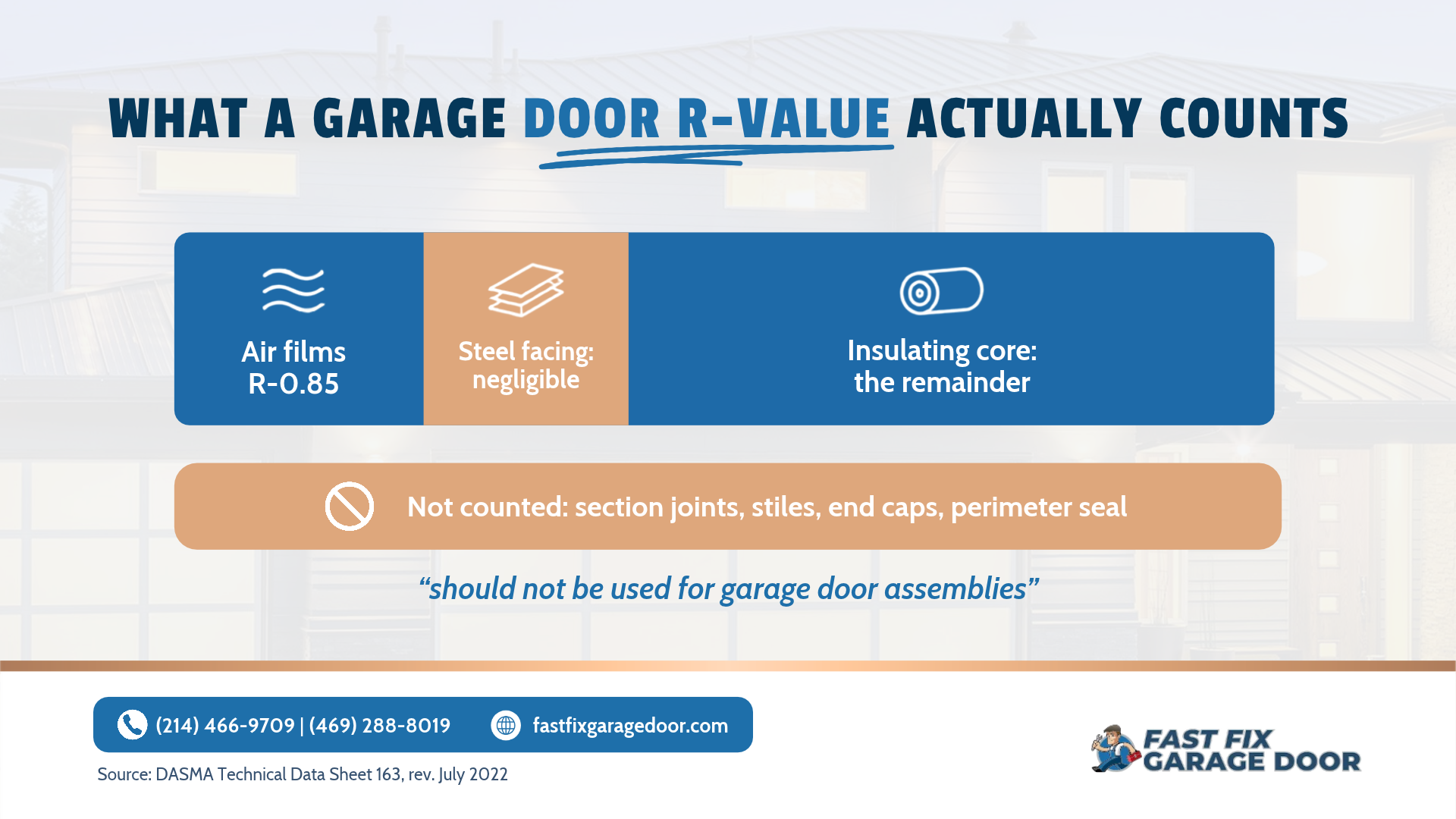
The calculation in TDS-163 runs as a sum. Air films, plus the outside surface, plus the insulation, plus the inside surface. The air films are the thin, still layer of air clinging to each face of a closed door, and DASMA puts their combined value at R-0.85, drawing on published ASHRAE data. The assumption is stagnant air inside the garage and air moving at 15 miles per hour outside.
The steel skins contribute almost nothing. R-values of steel and other metal facings, the sheet says, are considered negligible.
So on a door advertised at R-6, roughly R-0.85 of that came from air and effectively none of it from the steel. The core is doing the rest. That is simply how the arithmetic works, and it explains why the gap between an R-6 door and an R-9 door is smaller in practice than the gap between the two numbers looks.
| What goes into the calculated number | Contributes |
| Air films, inside and outside faces | R-0.85 |
| Steel or metal facings | Negligible |
| Insulating core | The remainder |
| Section joints, stiles, end caps, perimeter seal | Nothing. Not in the calculation |
Nobody Is Required to Test It
Here is the part that surprises people, and it is worth stating carefully because it is easy to get wrong in either direction.
The Federal Trade Commission runs a rule on R-value claims, 16 CFR part 460. It is detailed. Section 460.5 sets out exactly which ASTM test methods an R-value must come from, and requires the tests be run at a mean temperature of 75 degrees Fahrenheit with a 50-degree difference across the material. It also requires the test be done “on the insulation material alone (excluding any airspace).”
Section 460.22 extends that to products that are not insulation but are sold partly on their ability to slow heat flow. If you advertise an R-value for one of those, you have to test it properly, and the claim has to fairly reflect the results.
And then it carves out doors. For the purposes of that section, the rule says, “fenestration-related products include windows, doors, and skylights as well as attachments for those products.”
A garage door is a door. So the federal rule that would otherwise force a tested, substantiated R-value on a product sold for slowing heat flow does not reach it. That is not an accusation against any manufacturer, and plenty of them publish honest, carefully calculated figures. It does explain why the numbers vary so much between brands that appear to be selling the same thing, and why asking for the test behind the number is a fair question rather than a rude one.
Where a North Texas Door Actually Loses
We work across Collin County and the surrounding suburbs, and the pattern in an attached garage here is consistent enough to describe.
The garage door is usually the largest single surface on the house that has no insulation behind it, no house wrap, and a perimeter that opens twice a day. On a west-facing elevation in Richardson, it takes direct afternoon sun for hours, and the steel skin gets hot enough to be uncomfortable to touch. Whatever the core is doing, the heat that gets past the door has a second job to do before it reaches you, because most of these garages share a wall and a ceiling with the living space.
None of that is in the R-value. The calculation assumes a flat section and 15 miles per hour air on the outside face. It does not model a stationary door baking in still air at four in the afternoon in August.
What we actually see failing, in rough order of how often:
- The bottom seal. A flattened or hardened astragal leaves a gap you can see daylight through. It is the cheapest thing on this list to fix and usually the biggest single change.
- The perimeter stop moulding. Warped or shrunk away from the jamb, especially on doors that have been through a few Texas summers.
- Section joints. The line between panels on a cheaply built door is a straight thermal path from outside to inside. This is precisely what the R-value calculation excludes.
- End caps and stiles. Steel members running through the core, bridging the insulation. Excluded again.
- The core itself. Which is the only part the sticker describes.
That ordering is not an accident. Four of the five sit at an edge or a joint, and edges are where a garage door is least like the flat panel the calculation imagines. A door is five or six rigid sections hinged together, hung in an opening it does not quite fill, with a rubber strip along the bottom that has to seal against a slab that is rarely perfectly level. Every one of those interfaces is a path.
Slab movement makes this worse here than it would be somewhere with more forgiving ground. Expansive clay across this part of North Texas lifts and drops through the wet and dry cycle, and a garage slab that has moved even slightly leaves a bottom seal bearing on one corner and floating at the other. The door looks closed. Standing inside with the lights off, you can see the daylight.
That ordering matters if you are trying to decide where money goes. A homeowner who replaces an R-6 door with an R-12 door and leaves a hardened bottom seal in place has spent a lot to fix the fifth item on the list.
What to Ask in the Showroom
Four questions, and they are all reasonable to ask of anyone selling you a door.
- Is that a tested U-factor or a calculated R-value?
If the answer is a U-factor, ask whether it was tested to ANSI/DASMA 105 on a complete assembly. That is the figure that describes a door rather than a slice of one. - What is the core, and how thick?
Polyurethane foamed in place generally outperforms polystyrene board of the same thickness, because it bonds to both skins and fills the cavity rather than sitting in it. Thickness and material together tell you more than the headline number.
- Is the door thermally broken?
A thermal break interrupts the metal path between the outside and inside skin. Without one, the frame conducts heat around the core no matter what the core is rated at. - What seals come with it, and what is the warranty on those specifically?
Seals are consumable. Knowing the replacement interval up front is more useful than a longer number on the panel warranty.
When Insulation Is the Wrong Thing to Buy
We would rather say this plainly than sell an upgrade that will not do what somebody hopes.
If the garage is detached and nothing above or beside it is conditioned, an insulated door changes how the garage feels and very little else. It is a comfort purchase, legitimate enough if you spend time in there, and it will not show up on a utility bill.
If the door is old enough that the springs are near the end of their cycle count, the door’s insulation is not the decision in front of you. Heat is already shortening that count in a North Texas garage, and the sequencing matters.
And if the real complaint is that the garage is unbearable rather than that the house is, the door is one of four or five surfaces involved. The ceiling above it, the shared wall, the attic hatch, and the effect of humidity and temperature swings on the door itself all belong in the same conversation.
Where an insulated door does earn its keep is the attached garage with a room over it or beside it, on a west or south elevation, where the door is the weakest surface in the envelope, and everything else has already been addressed.
One Number Worth Chasing
A U-factor tested to ANSI/DASMA 105 is the only figure here measured on the product you will own. Ask for it.
What Changes After the Door Goes On
An insulated door is heavier than the one it replaces, sometimes by a hundred pounds or more on a double, and that weight has to be carried by the spring system.
This is the part that gets skipped, and it is the part that comes back as a service call eighteen months later. Springs are specified to a door’s weight and to a cycle count. Fitting a heavier door on the old springs means every cycle runs closer to the limit, which shortens the life of the whole assembly and puts more load on the opener at the same time. A door that was quiet and balanced in March starts labouring by the following summer.
Any competent installer will re-spring for the new weight as part of the job. It is worth confirming out loud that they have, because it is not visible from the driveway, and finding out through a garage door repair call on a January morning is the expensive way.
The same applies to a retrofit insulation kit. Adding panels to an existing door adds weight without anyone recalculating anything, which is why we would rather check the balance before and after than be called about a strained opener later.
A Quieter Door, Which Nobody Puts on the Sticker
One benefit goes unmentioned in the ratings and gets raised by customers constantly.
A door with a bonded core is stiffer than a hollow one, because the foam adheres to both skins and makes the section behave as a single panel rather than two sheets with a gap. Stiffer sections flex less as they travel the curve of the track. Less flex means less of the drumming and rattling that carries straight through an attached wall into whatever room sits behind it.
Households with a bedroom over the garage notice this within a week. Households whose garage backs onto a home office notice it on the first call they take. Neither group tends to mention the energy bill, which is worth remembering when a quote is being justified entirely on energy.
On its own, that should not push you to the highest-rated door in the showroom. It should stop you from judging the decision purely on a number that was never measuring the thing you are going to live with.
What We Would Do First
Before anything gets quoted, close the door on a dry afternoon and stand inside the garage with the lights off. Daylight around the perimeter tells you more in thirty seconds than any sticker will, and it costs nothing.
If you see light along the bottom, the seal is the first job. If you see it up the sides, the stop moulding is. If the door is sound, sealed and simply thin, then the R-value conversation is worth having, and it is worth having with a tested U-factor in hand.
When you want a second opinion on which of those you are actually looking at, our team covers Richardson and the surrounding suburbs and will tell you if the answer is a twenty-dollar seal.
That is the whole offer here. Fast Fix Garage Door would rather sell you a seal you needed than a door you did not.